
WordPress Development & Digital Architecture for Physical Medicine & Rehabilitation (PM&R) and Interventional Pain Management Practices
A Comprehensive Guide to Building Accessible, High-Performing, and HIPAA-Compliant Websites for Physiatrists and Pain Specialists
Executive Summary
Modern medicine is increasingly defined by the digital gateway. For specialists in Physical Medicine & Rehabilitation (PM&R)—also known as physiatrists—and interventional pain management practitioners, a website is far more than a digital brochure. It is a critical component of patient care, clinical education, and practice operations.
Patients seeking these specialties are frequently in significant physical discomfort, experiencing cognitive load from chronic pain, or navigating mobility impairments. Consequently, their digital interaction with your clinic must be friction-free, highly accessible, and deeply educational.
At AMJ Digital Pro, we specialize in translating complex clinical workflows and multidisciplinary treatment models into high-performing, secure, and accessible WordPress ecosystems. This guide provides an in-depth analysis of the technical, structural, and strategic factors involved in planning, developing, and optimizing a website tailored specifically to PM&R and pain management clinics.
The Clinical Reality of PM&R & Pain Management Digital Presence
Physical Medicine & Rehabilitation and Interventional Pain Management are unique medical subspecialties. Unlike primary care or highly localized surgical practices, your clinical offerings span a wide spectrum: non-operative musculoskeletal care, fluoroscopy-guided interventional procedures, regenerative medicine, electrodiagnostic testing (EMG/NCS), sports medicine, and comprehensive neuro-rehabilitation.
This clinical diversity presents a distinct communication challenge. A prospective patient suffering from chronic discogenic back pain requires a completely different informational path than an athlete seeking platelet-rich plasma (PRP) therapy for a tendon injury, or a family coordinator researching stroke rehabilitation options.
Addressing the Patient State of Mind
When designing a digital interface for patients experiencing acute or chronic pain, several psychological and physiological factors must guide the development process:
Chronic pain impairs executive function and working memory. Information must be structured hierarchically, using clear, jargon-free headings and micro-copy.
Patients with spinal cord injuries, severe arthritis, or neurological conditions may rely on assistive technologies (screen readers, keyboard-only navigation) or have difficulty using precise mouse movements.
Patients who have spent years searching for relief are often skeptical of overly promotional marketing materials. They seek evidence-based explanations of procedures, clinical outcomes, and clear provider credentials.
To meet these complex requirements, generic templates and automated, closed-system builders are fundamentally inadequate. Achieving the necessary balance of performance, security, and specialized content requires professional, custom-engineered PM&R medical website design that honors the scientific precision of your practice.
Choosing the Right Development Partner
Healthcare website development is a highly regulated and technically demanding field. Selecting a generic web developer who lacks familiarity with medical marketing guidelines, HIPAA requirements, and the specific nuances of physiatry can lead to costly redesigns, compliance vulnerabilities, and poor user adoption.
Working with a specialized website developer for physical medicine and rehabilitation ensures that your digital infrastructure is built around your real-world clinical operations.
Why Generalist Agencies Fall Short
A generalist agency often treats a medical website like an e-commerce platform or a B2B service page. They may overlook:
- Clinical Nomenclature: Confusing “physiatry” with “physical therapy” (a common and frustrating error that misleads patients and lowers search credibility).
- HIPAA Compliance: Failing to properly secure contact forms, online appointment requests, or live chat integrations, exposing the practice to severe regulatory penalties.
- Complex Treatment Hierarchies: Grouping highly technical interventional procedures (like radiofrequency ablation or intrathecal pump management) in a disorganized manner that confuses patients and referral sources alike.
An experienced developer acts as a clinical translator, building custom WordPress post types, custom taxonomies, and interactive anatomy maps that align perfectly with how a physiatrist or interventionalist actually diagnoses and treats patients.
The Anatomy of High-Converting Interventional Pain Management Website Design
Converting a website visitor into a scheduled patient requires a strategic combination of visual comfort, educational authority, and clear, non-coercive calls to action (CTAs).
Our approach to interventional pain management website design focuses on creating a “digital sanctuary” for the patient. By utilizing calming, clinical-neutral color palettes (such as deep blues, soft greens, and warm slate), high-contrast typography, and intuitive navigation paths, we minimize the friction that often prevents patients in pain from seeking care.
Essential Structural Components
- Condition-to-Treatment Mapping: Instead of isolating conditions (e.g., lumbar spinal stenosis) and treatments (e.g., epidural steroid injections) on separate, disconnected pages, we develop interactive, bidirectional relationships. When a patient reads about their condition, the relevant, evidence-based treatments are dynamically linked and displayed alongside it.
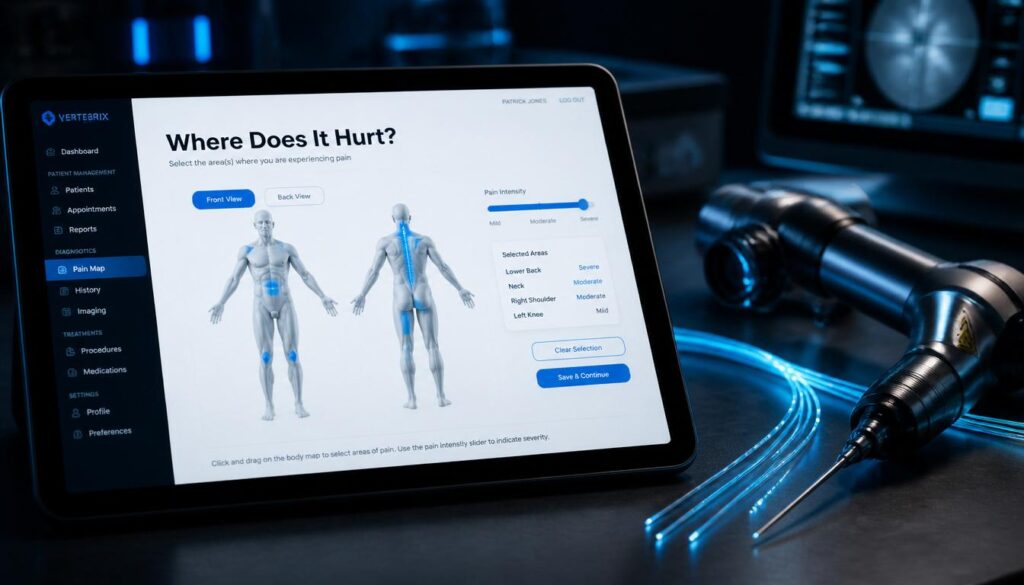
- The “Where Does It Hurt?” Interactive Body Map: A visually engaging, highly accessible interactive anatomy tool allows patients to tap on a region of the body (e.g., lower back, neck, knee) to instantly access a curated list of conditions and treatment options. This bypasses complex medical terminology search queries and guides patients directly to relevant content.
- Clear Provider Bios and Philosophy of Care: In PM&R, the goal is often functional restoration and conservative management rather than immediate surgery. Provider biographies must clearly articulate this non-operative, patient-centered philosophy to build trust with patients who wish to avoid major operations.
The Limitations of Generic Builders vs. Custom WordPress Architecture
Many practices initially consider using proprietary, drag-and-drop website builders due to perceived ease of use. However, relying on a closed-source physiatrist website builder presents significant long-term risks and functional limitations for growing practices.
| Feature / Capability | Generic Proprietary Builders | Custom WordPress (AMJ Digital Pro) |
|---|---|---|
| Data Ownership | Proprietary code; cannot export database or migrate host easily. | 100% open-source; you own your files, database, and content. |
| SEO Flexibility | Limited metadata customization, poor schema markup control. | Full programmatic control over schema, site speed, and indexing. |
| HIPAA Compliance | Difficult to secure; limited third-party form integrations. | Native integration with HIPAA-compliant forms, portals, and schedulers. |
| Scalability | Hard-capped page limits and rigid structural templates. | Unlimited growth; supports multi-location, multi-provider scaling. |
| Performance (Speed) | Bloated, generic scripts that slow down mobile load times. | Clean, semantic code optimized for core web vitals and mobile speed. |
Custom WordPress development allows for the creation of custom database structures. For example, we can build a “Provider” custom post type, a “Location” custom post type, and a “Service” custom post type, and dynamically link them. If your practice expands to a third location with two new doctors, adding them to the database automatically updates their bios across all relevant service pages, location directories, and scheduling forms without requiring tedious manual updates.
User Experience (UX) & Accessibility: Web Design for Pain Relief Clinics
Accessibility is not merely a legal checkbox under the Americans with Disabilities Act (ADA) and Web Content Accessibility Guidelines (WCAG); it is an essential component of clinical empathy.
When executing web design for pain relief clinics, we prioritize universal design principles that accommodate patients experiencing varying degrees of physical discomfort, tremors, or visual impairment.
Universal Design and WCAG Best Practices
For patients suffering from severe osteoarthritis, peripheral neuropathy, or hand tremors, clicking tiny icons is frustrating. We ensure all interactive elements have a minimum touch target size of 48x48 physical pixels.
We avoid ultra-thin fonts and low-contrast color combinations. We strictly adhere to WCAG AA standards, maintaining a contrast ratio of at least 4.5:1 for normal text to ensure readability for visually impaired patients.
Every page must be navigable using only the Tab and Enter keys. All images feature meaningful alt text, and form inputs have explicit programmatic labels so screen readers can accurately interpret the interface.
We strictly prohibit autoplaying videos, aggressive pop-up modals, and flashing graphics. These elements can cause cognitive overload or trigger sensory sensitivities in patients managing severe pain.
Engineering Secure, HIPAA-Compliant Pain Management Practice Web Development
Data security is paramount in healthcare. The Department of Health and Human Services (HHS) strictly regulates how Protected Health Information (PHI) is collected, transmitted, and stored online.
Our specialized framework for pain management practice web development ensures that your website acts as a secure, compliant fortress, protecting both your patients and your practice from liabilities.
Technical Measures for Compliance and Security
- Secure Socket Layer (SSL/TLS): We implement enterprise-grade TLS 1.3 encryption protocols across the entire domain, ensuring all data in transit is fully encrypted.
- HIPAA-Compliant Form Integrations: Standard WordPress forms store submissions directly in the local database or transmit them via unencrypted emails. We integrate secure, HIPAA-compliant form builders (such as Jotform Enterprise or Formstack) that sign Business Associate Agreements (BAAs). These forms securely transmit data directly into your Electronic Health Record (EHR) or a secure, encrypted database, bypassing the local WordPress site entirely.
- Secure API Integrations: Whether connecting to patient portals like Athenahealth, eClinicalWorks, or MyChart, or incorporating secure scheduling systems like Zocdoc or NexHealth, we construct custom API bridges that maintain strict security perimeters.
- Hardened WordPress Security Protocols: We implement server-level firewalls, daily malware scanning, automated core and plugin updates, two-factor authentication (2FA) for administrative users, and disable default WordPress REST API endpoints that could expose database vulnerability points to malicious actors.
Search Engine Optimization (SEO) & Patient Acquisition Strategy
A beautifully designed website is only effective if patients and referring physicians can easily find it. Search engine optimization (SEO) for PM&R and pain clinics is highly competitive and heavily regulated under Google’s “Your Money or Your Life” (YMYL) content guidelines. Google demands an exceptionally high standard of Experience, Expertise, Authoritativeness, and Trustworthiness (E-E-A-T) for medical queries.
Partnering with AMJ Digital Pro, a specialized sports medicine and PM&R website design agency, gives your practice an immediate competitive edge. We understand how to structure and optimize content to satisfy both Google’s search algorithms and the precise informational needs of patients.
The Key Pillars of Medical SEO
Technical Local SEO & Schema Markup
Most patients seek pain relief or sports medicine care locally. We implement advanced LocalBusiness, MedicalBusiness, and Physician schema markup. This structured data tells search engines exactly where your offices are located, your clinical hours, which insurances you accept, and the specific procedures your doctors perform. This increases your chances of appearing in the coveted Google Maps "Local 3-Pack."
E-E-A-T Content Structure
Every piece of medical content must be medically reviewed and attributed to a licensed provider. We build custom author boxes that link to the provider's bio, NPI registry, and academic credentials, signaling to Google's quality raters that your content is trustworthy and written by qualified medical professionals.
Voice Search and Natural Language
Patients rarely search for "lumbar radiculopathy treatment." Instead, they search for, "Why does my leg go numb when I sit down?" or "best doctor for back pain without surgery near me." We build comprehensive, natural language FAQ sections targeting these specific conversational long-tail queries, capturing high-intent local search traffic.
Core Web Vitals & Mobile Speed
Mobile performance is a direct ranking factor. Patients in pain searching for emergency care on their mobile devices will quickly abandon a slow-loading site. We optimize all images, leverage modern web formats (WebP), implement advanced page caching, and minimize render-blocking JavaScript to ensure your site loads in under two seconds on all devices.
Seamless Workflow Integrations for Clinic Operations
Your website should be an active extension of your clinic's administrative team. By integrating modern digital workflows, we can significantly reduce the administrative burden on your front-desk staff while improving the patient experience.
Instead of hand-writing medical history on clipboards in the waiting room, patients can complete secure, pre-appointment intake forms online. These forms can be digitally signed and securely uploaded directly into your EHR, reducing errors and saving valuable clinical time.
Integrate real-time scheduling platforms that allow patients to book appointments directly based on provider availability. This dramatically reduces call volumes and allows patients to schedule appointments at their convenience, even outside of normal business hours.
For PM&R follow-ups, medication management, or initial consultations, we can build secure virtual waiting rooms and telehealth integration portals that make remote care simple and accessible for patients with limited mobility.
Make it incredibly easy for primary care physicians, orthopedic surgeons, and neurologists to refer patients to your practice. We build dedicated, streamlined referral portals where external clinics can securely upload patient charts, imaging, and insurance authorizations with just a few clicks.
The AMJ Digital Pro Collaborative Development Process
We believe that building a medical website is a collaborative clinical and creative partnership. Our proven five-step process is designed to ensure complete transparency, security, and exceptional performance at every stage of development.
We analyze your practice. We identify your primary patient demographics, key procedural focus areas, geographic footprint, and operational goals. We review existing brand assets, local competitors, and referral networks.
We map out the user experience, focusing heavily on intuitive navigation, accessible design, and content pathways. We create interactive wireframes that show how patients and referring physicians will move through your site.
Our developers translate the approved designs into a fast, secure, and fully customized WordPress environment. We write clean, semantic code from scratch, avoiding bloated third-party page builders.
We assist in migrating existing content or developing new, SEO-optimized copy. Our medical writers ensure clinical descriptions are accurate, accessible, and compliant with medical advertising standards.
We run your website through a rigorous 150-point QA checklist testing speed, mobility, and accessibility. We verify all forms are fully HIPAA-compliant. Once approved, we execute a seamless transition with zero downtime.
Is WordPress secure and HIPAA-compliant for a pain management website?
How do you handle integration with our EHR and Patient Portal?
Can you build separate landing pages for multiple clinic locations?
What is your approach to ADA accessibility and compliance?
How long does a custom PM&R web development project take?
Partner with the Specialists in Medical Digital Architecture
Your clinical expertise helps patients reclaim their lives, restore their function, and manage their pain. Your website should reflect that same high level of care, precision, and professionalism.
Don't leave your practice's digital gateway to generic platforms or inexperienced developers. Partner with AMJ Digital Pro to construct a highly secure, accessible, and high-converting digital platform that respects your patients, empowers your staff, and accelerates your clinical growth.
Contact AMJ Digital Pro today to schedule a comprehensive digital architecture consultation for your practice.
Schedule Your Consultation