
WordPress Development for Orthopedic Surgery & Sports Medicine Websites
An Authoritative Guide to Building Secure, Patient-Centric, and Search-Optimized Digital Practices
Executive Summary: The Modern Musculoskeletal Digital Gateway
In the modern healthcare ecosystem, a medical practice’s website is no longer a static brochure. It is the virtual front door, a clinical navigation portal, and a primary engine for patient acquisition and education. For orthopedic surgeons, joint replacement specialists, and sports medicine physicians, the digital experience must mirror the precision, excellence, and sophistication of the surgical suite.
Patients seeking orthopedic care are often in pain, suffering from restricted mobility, or anxious about returning to their active lifestyles. Their digital journey should not add to their frustration. A slow, disorganized, or generic website can inadvertently signal a lack of specialized care. Conversely, an intuitive, educational, and high-performing website establishes immediate clinical authority, builds trust, and streamlines the path from initial injury search to the first outpatient consultation.
This comprehensive guide explores the structural, technical, and compliance frameworks required to design, build, and optimize a world-class digital presence for orthopedic and sports medicine practices using WordPress—the world’s most flexible and scalable content management system.
Why Generic Platforms Fall Short for Orthopedic Practices
When clinical directors or practice administrators seek to launch or redesign their online presence, they are often faced with a fundamental platform choice. Many turn to simplified, proprietary drag-and-drop platforms. However, relying on a generic medical website builder for orthopedic surgeons often introduces severe, long-term technical bottlenecks.
While these proprietary builders promise rapid deployment, they present distinct limitations for specialized medical groups:
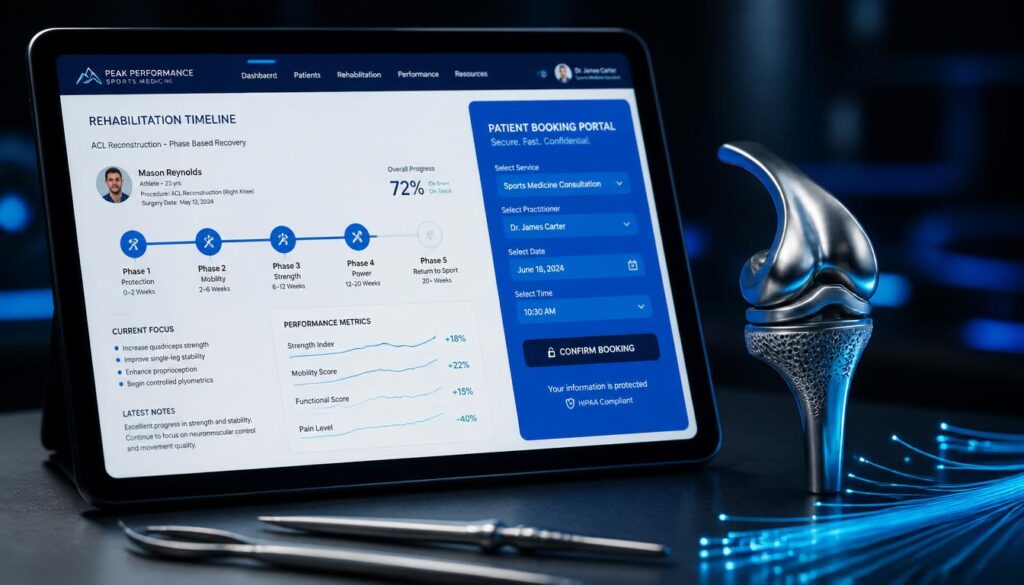
Generic builders operate on closed ecosystems. If your practice decides to integrate a complex third-party scheduling engine or wants to build a custom interactive joint-replacement rehabilitation timeline, you will quickly hit the boundaries of what their proprietary APIs allow.
To cater to millions of different industries, drag-and-drop systems bundle massive amounts of unused JavaScript and CSS. WordPress, when developed cleanly by a specialist, allows for absolute control over asset loading, minimizing code bloat and accelerating speed.
Search engines prioritize structured data, lightning-fast load times, and clear content hierarchies. Generic builders often restrict access to advanced server-side optimization, custom schema markup, and granular URL structuring, limiting your practice's ability to rank.
The WordPress Alternative
WordPress powers over 40% of the internet because it offers complete ownership. It provides an open-source architecture where custom post types can be engineered to manage complex clinical data (such as provider profiles, clinical locations, and patient education libraries) without relying on heavy, unoptimized plugins. For a surgical practice looking to grow its patient volume, scale its clinical locations, and establish a dominant brand, WordPress offers the only truly future-proof foundation.
Clinical Information Architecture: Organizing the Patient Journey
An orthopedic website must accommodate diverse patient populations. A 17-year-old high school athlete with an acute ACL tear requires a completely different navigational path and tone than a 72-year-old grandmother seeking relief from chronic knee osteoarthritis.
A specialized orthopedic practice web developer designs the site’s architecture around distinct “clinical pathways.” This ensures that every visitor can find highly relevant information within two clicks of landing on any page.
- Knee & Hip
- Shoulder
- Spine & Neck
- Hand & Wrist
- Bio Profiles
- Specializations
- Location Maps
- Intake Forms
- Billing/Insurance
- Prep Guides
1. Anatomical and Condition-Based Navigation
Rather than grouping all treatments under a single, generic “Services” page, the site should be structured around anatomical regions or specialties:
- Joint Replacement & Reconstruction (Hip, Knee, Shoulder)
- Sports Medicine (Ligament repairs, cartilage restoration, joint preservation)
- Spine Care (Decompression, minimally invasive spine surgery, disc replacement)
- Hand, Wrist, and Upper Extremity
- Foot and Ankle Care
- Orthopedic Trauma & Fracture Care
Each anatomical silo should contain comprehensive sub-pages dedicated to specific conditions (e.g., Meniscus Tears) and their corresponding treatments (e.g., Arthroscopic Meniscectomy or Meniscal Repair). This clear hierarchical structure signals to search engines that your site is an authoritative resource on these specific medical procedures.
2. Dynamic Provider Directories
For multi-physician practices, the doctor’s biography page is often the highest-trafficked page on the entire site. Patients want to see where their surgeon went to school, their board certifications, their active research, and their patient philosophy.
By leveraging WordPress Custom Post Types (CPTs), we build dynamic provider directories. This allows the practice to update a physician’s bio, clinical locations, accepted insurances, and patient testimonials in one central dashboard, automatically pushing those updates to every related treatment page across the website.
The Mechanics of High-Performance Sports Medicine Design
Designing for sports medicine requires a distinct visual strategy compared to general orthopedics. While general orthopedic pages focus on pain relief, mobility restoration, and safety, sports medicine pages must convey energy, recovery, human performance, and rapid return to play.
Expert sports medicine website design centers on balancing dynamic, high-resolution imagery of active lifestyles with clean, clinical layouts that preserve professional credibility.
| Feature Category | High-Performance Design Requirements | Patient-Impact Focus |
|---|---|---|
| Visual Aesthetic | High-contrast, dynamic imagery, clean sans-serif typography, subtle motion cues. | Inspires confidence, showcases active recovery and return to physical activities. |
| Media Assets | Custom videography, animated anatomical models, physician-led clinical video summaries. | Demystifies surgical processes, reduces patient anxiety, increases on-page time. |
| Mobile UX | Thumb-friendly navigation, highly legible fonts, rapid touch-responsive elements. | Ensures injured patients or those with hand/wrist issues can navigate effortlessly. |
| Interaction Design | Non-disruptive, highly accessible transitions; absolute compliance with ADA standards. | Prioritizes usability for patients of all ages, screen readers, and motor-ability levels. |
Video and Rich Media Integration
Static text alone is no longer sufficient to explain complex surgical concepts. Integrating high-definition video backgrounds, interactive anatomical diagrams, and short video clips of surgeons explaining common sports injuries (like rotator cuff tears or labral tears) dramatically boosts patient engagement. However, these media assets must be highly optimized. We utilize lazy loading, modern video codecs (WebM), and content delivery networks (CDNs) to ensure that rich media does not degrade mobile page speeds.
HIPAA Compliance, Security, and Data Integrity
Any website operating in the healthcare sector must treat security and compliance as a non-negotiable priority. For orthopedic clinics, capturing patient information via online scheduling requests, contact forms, or pre-operative intake portals exposes the website to the Health Insurance Portability and Accountability Act (HIPAA) regulations.
1. Securing Protected Health Information (PHI)
Standard WordPress contact forms store form submissions directly in the WordPress database or transmit them via unencrypted emails. This is a severe HIPAA violation. To mitigate this risk, we implement strict data transmission protocols:
- Third-Party HIPAA Form Integration: We embed secure, HIPAA-compliant form engines (such as Jotform Enterprise, Formstack, or Cognito Forms) that sign a Business Associate Agreement (BAA) with your practice.
- Zero-PHI Local Databases: We configure the WordPress server so that no personally identifiable information (PII) or clinical history is stored locally within the database.
- Secure SMTP Relays: Any transaction emails generated by the site are routed through secure, encrypted SMTP servers designed specifically for medical communication.
2. Enterprise-Grade Security Hardening
Because WordPress is an open-source platform, it is a frequent target for automated bots and malicious actors. Protect your clinic’s brand reputation with robust server and application-level hardening:
- Web Application Firewalls (WAF): Implementing enterprise security layers like Cloudflare Enterprise to block malicious traffic, SQL injection attempts, and DDoS attacks before they reach your hosting server.
- Two-Factor Authentication (2FA): Enforcing mandatory 2FA for all administrative accounts, including clinical staff, content editors, and marketing managers.
- Real-Time Activity Auditing: Installing audit logs to track precisely who logs in, what files are modified, and when content is updated.
- Automated Vulnerability Patching: Setting up isolated staging environments to test and safely apply core, theme, and plugin updates without interrupting live patient booking pathways.
Technical SEO Architecture for Orthopedic & Sports Medicine Practices
Organic search traffic is highly valuable for orthopedic groups. When a patient experiences sudden knee instability or chronic shoulder pain, their first step is almost always typing their symptoms or suspected diagnosis into a search engine. To capture these prospective patients, your website must be built on a structurally sound search engine optimization framework.
As a specialized orthopedic surgeon web design agency, we build SEO into the foundational code of your website, rather than treating it as an afterthought.
1. Semantic Schema Markup (Structured Data)
Search engine crawlers are highly sophisticated, but they require explicit clues to understand the relationship between your medical providers, physical clinic locations, and the surgical procedures you perform. We write and deploy custom JSON-LD schema markup across your entire site, including:
- MedicalBusiness Schema: Declares your practice name, physical address, geo-coordinates, phone number, and accepted insurances.
- Physician Schema: Uniquely identifies each surgeon, linking their individual bio page to their NPI number, medical school, residency, board certifications, and specific clinical specialties.
- MedicalCondition & MedicalProcedure Schema: Explicitly defines treatment pages (e.g., Total Hip Arthroplasty) as recognized medical procedures, helping Google present your content as highly authoritative rich snippets in search results.
<script type="application/ld+json">
{
  "@context": "https://schema.org",
  "@type": "Physician",
  "name": "Dr. Sarah Jenkins, MD",
  "medicalSpecialty": "OrthopedicSurgery",
  "knowsAbout": ["Knee Arthroplasty", "Anterior Cruciate Ligament Reconstruction", "Meniscal Repair"],
  "provider": {
    "@type": "MedicalOrganization",
    "name": "AMJ Orthopedic & Sports Medicine Clinic"
  },
  "address": {
    "@type": "PostalAddress",
    "streetAddress": "123 Mobility Way, Suite 400",
    "addressLocality": "Metro City",
    "addressRegion": "ST",
    "postalCode": "12345"
  }
}
</script>
2. Strategic Keyword Mapping and Content Siloing
We structure content around highly targeted local and clinical search intents. This systematic approach ensures that your content answers the specific questions patients are asking, matching local search criteria in your geographic markets.
Our holistic strategy is packaged within comprehensive medical SEO and website design packages that coordinate code structure, user experience, and ongoing content growth. We divide our targeting into three key buckets:
- High-Intent Local Queries: e.g., “Orthopedic surgeon near me,” “Sports medicine clinic [City Name].”
- Procedure-Specific Queries: e.g., “Outpatient partial knee replacement,” “Minimally invasive rotator cuff repair.”
- Informational Symptom Queries: e.g., “Why does my knee pop when climbing stairs,” “When to see a doctor for shoulder pain.”
By writing deep-dive, medical-director-reviewed content hubs that answer these questions and linking them back to your treatment pages, we establish your surgeons as the go-to regional authorities in their specialty fields.
Patient-Centric UX: Accessibility & Conversions
A beautiful website is ineffective if patients struggle to book an appointment or find your office location on their mobile devices. To optimize conversions, we design around the physical realities of the orthopedic patient.
1. ADA & WCAG Accessibility Compliance
Patients suffering from severe arthritis, hand injuries, tremors, or visual impairments must be able to use your website with absolute ease. We design to meet Web Content Accessibility Guidelines (WCAG) 2.1 AA standards:
- Keyboard Navigability: Ensuring every interactive element, drop-down menu, and form can be navigated entirely using the “Tab” key.
- Screen-Reader Compatibility: Injecting descriptive aria-labels and alt text on every surgical diagram, chart, and button.
- Contrast and Legibility: Utilizing high-contrast typography and adjustable font size tools to assist visually impaired patients.
- Interactive Target Sizes: Engineering buttons, scheduling calendar boxes, and navigation tabs with generous hit targets (minimum 44×44 pixels) so patients with limited manual dexterity can click them easily.
2. Streamlined Conversion Funnels
We map the physical and psychological steps a patient takes when seeking orthopedic care, optimizing each transition point:
By ensuring that a secure, mobile-friendly appointment request form is always accessible, we dramatically lower the barriers to entry, turning casual visitors into active patients.
Selecting the Right Technical Partner for Your Practice
Building a medical website is a complex undertaking that requires both technical expertise and an understanding of clinical care. If you choose to hire developer for orthopedic clinic website operations, you must ensure that your partner understands healthcare marketing regulations, medical terminology, and patient acquisition pathways.
A qualified developer should understand the administrative side of running a busy medical group. They should know how to work alongside your practice managers, compliance officers, and clinical directors to build solutions that save operational time, reduce patient-care phone traffic, and protect sensitive medical data.
The AMJ Digital Pro Difference: Our Tailored Methodology
At AMJ Digital Pro, we do not believe in templates, generic designs, or outsourcing technical development. We approach orthopedic and sports medicine web design as a precise science. Our proven methodology ensures that your project is delivered on time, within budget, and fully compliant with all modern web and healthcare standards.
We begin by studying your practice’s unique footprint. We analyze your volume goals, identify your target orthopedic specialties (such as joint preservation or sports medicine), review your patient demographics, and map out your current clinical systems.
We build custom UI/UX blueprints, designing the patient journey down to the click. We present these layout wireframes for your team’s review, ensuring that the visual hierarchy aligns perfectly with your practice’s brand guidelines and clinical focus.
Our engineering team builds your custom WordPress theme from scratch. We write clean, compliant HTML5, CSS3, and JavaScript, strictly adhering to WordPress VIP coding standards. We avoid heavy pre-made themes, ensuring your site loads quickly and runs securely.
Our search team sets up your local SEO architecture, designs your content silos, and writes custom schema markup. We optimize all text, images, and video assets to ensure your site is ready to rank for competitive clinical search queries.
Before launch, your website undergoes a thorough quality assurance process. We test it on dozens of real mobile devices, check for WCAG accessibility compliance, audit security configurations, and run comprehensive speed benchmarks.
Comprehensive Care and Optimization Packages
A successful website requires ongoing support. Our medical SEO and website design packages are structured to provide continuous, high-level technical care, helping your digital footprint grow alongside your physical practice.
Our post-launch care includes:
- Continuous Speed Optimization: Monthly reviews of your Core Web Vitals to keep your site fast on all devices.
- Security Audits & Patch Management: Constant threat monitoring, firewall tuning, and weekly, sandboxed plugin and core updates.
- Local SEO and Reputation Growth: Ongoing strategy to improve local Map Pack rankings and help you manage patient feedback.
- Content Updates: Streamlined support for adding new providers, clinical locations, insurances, or surgical technologies to your site.
Is WordPress secure enough to host our medical clinic’s website?
How long does a custom orthopedic website redesign take?
Will our clinic’s staff be able to update content easily?
Elevate Your Practice’s Digital Presence
Your patients deserve orthopedic care that is precise, comprehensive, and tailored to their needs. Their digital experience should be no different. Partner with a specialized team that understands how to translate surgical excellence into a secure, accessible, and high-ranking digital platform.
Contact AMJ Digital Pro today to schedule a technical consultation and review how we can help grow your clinical footprint.
Schedule Your Technical Consultation