Why Is Your Home Insurance Agency Missing From Google’s Local Map Pack?
When homeowners search online for insurance help, many of them never scroll past the top of the page. They type phrases like “home insurance near me” or “best homeowners insurance agency in my city,” and Google immediately shows a small section with maps, reviews, business names, phone numbers, and directions. This section is called the local map pack.
For home insurance agencies, appearing in Google’s local map pack can make a major difference in calls, website traffic, and qualified leads. Agencies listed there often receive the most visibility because searchers trust businesses that Google highlights first.
If your home insurance agency is not appearing in the local map pack, you are probably losing potential clients to competitors who are easier to find online.
The good news is that there are clear reasons why this happens, and most of them can be fixed with the right local SEO strategy.
What Is Google’s Local Map Pack?
Google’s local map pack is the group of local business listings that usually appears near the top of search results for location-based searches.
The map pack normally includes:
- • A map with business locations
- • Three featured businesses
- • Business reviews and ratings
- • Contact information
- • Website links
- • Directions
- • Business hours
For insurance agencies, the local map pack is one of the most valuable online marketing opportunities available.
When homeowners search for insurance providers, they are often ready to speak with an agent immediately. That means local map pack visibility can lead directly to calls, quote requests, and policy sales.
Why The Local Map Pack Matters For Home Insurance Agencies
Home insurance is a highly competitive market. Most cities have many agencies competing for the same clients.
People searching for homeowners insurance usually want:
- • Fast answers
- • Local expertise
- • Trusted providers
- • Strong reviews
- • Convenient communication
The map pack helps searchers compare agencies quickly.
If your agency is not there, many potential clients may never even know your business exists.
Appearing in the map pack can improve:
- • Brand visibility
- • Website traffic
- • Phone calls
- • Walk-in visits
- • Lead generation
- • Local trust
- • Conversion rates
For smaller insurance agencies, local map rankings can even outperform expensive advertising campaigns.
Your Google Business Profile Is Incomplete
One of the biggest reasons insurance agencies fail to rank in the local map pack is an incomplete Google Business Profile.
Your Google Business Profile is one of the strongest ranking factors for local SEO.
If your profile lacks important information, Google may not trust your business enough to display it prominently.
Common problems include:
- • Missing business categories
- • Incomplete service descriptions
- • No business hours
- • Missing phone number
- • Missing website link
- • No photos
- • Outdated address information
- • No service area listed
A complete profile helps Google understand:
- • What your business does
- • Where you operate
- • Which searches you should appear for
- • How relevant you are to local users
Insurance agencies should regularly update their profiles with accurate and detailed information.
You Chose The Wrong Business Categories
Your business category tells Google what type of company you operate.
If your primary category is inaccurate or too broad, Google may not connect your agency with home insurance searches.
Many agencies make mistakes such as:
- • Using general financial service categories
- • Choosing unrelated insurance categories
- • Failing to add secondary categories
A home insurance agency should use the most accurate insurance-related categories available.
Secondary categories can also help you appear for related searches involving:
- • Auto insurance
- • Renters insurance
- • Flood insurance
- • Property insurance
- • Business insurance
The more clearly Google understands your services, the better your local visibility can become.
Your Agency Has Too Few Reviews
Reviews are one of the most important local ranking factors.
Google wants to recommend businesses that appear trustworthy and popular.
If competing agencies have dozens or hundreds of positive reviews while your agency has very few, Google may rank them higher.
Reviews influence both rankings and customer behavior.
Potential clients often compare:
- • Number of reviews
- • Average rating
- • Review quality
- • Recent customer feedback
An agency with consistent positive reviews usually appears more credible.
Your Reviews Are Outdated
Even if your agency has reviews, they may not help much if they are old.
Google prefers businesses with ongoing customer engagement.
If your last review was several years ago, competitors with fresh reviews may outrank you.
Encouraging satisfied clients to leave reviews regularly can help improve visibility over time.
A steady flow of reviews signals that your business is active and still serving customers successfully.
Your Website Is Not Optimized For Local SEO
Many insurance agency websites are visually attractive but poorly optimized for local search.
Google uses website signals to support local rankings.
If your site lacks local relevance, your map pack visibility can suffer.
Common website problems include:
- • No city-specific pages
- • Weak location keywords
- • Missing title tags
- • Thin service pages
- • Slow page speed
- • Poor mobile usability
- • Missing contact information
- • No schema markup
Your website should clearly explain:
- • Where you operate
- • Which neighborhoods you serve
- • What insurance services you offer
- • Why homeowners should choose your agency
Strong local content helps Google connect your website with local searches.
You Are Ignoring Mobile Optimization
Most local insurance searches happen on mobile devices.
Homeowners often search for insurance agencies while:
- • Moving to a new home
- • Buying property
- • Comparing quotes
- • Reviewing policies
- • Looking for immediate help
If your website loads slowly or functions poorly on mobile phones, users may leave quickly.
Google notices poor user experiences.
Mobile-friendly websites generally perform better in local search rankings.
A mobile-optimized site should include:
- • Fast loading speeds
- • Click-to-call buttons
- • Easy navigation
- • Readable text
- • Simple contact forms
- • Responsive design
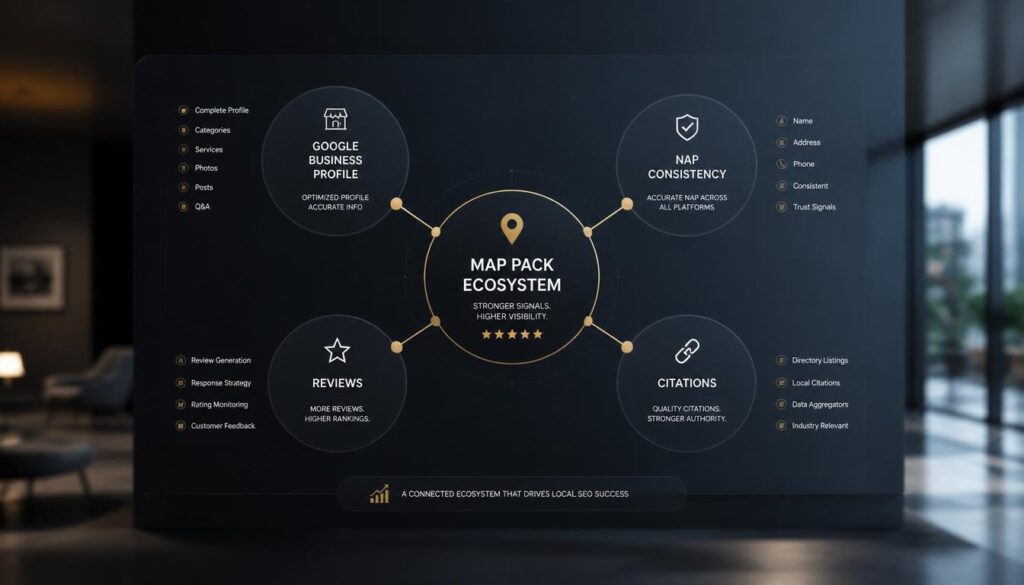
Your NAP Information Is Inconsistent
NAP stands for:
- • Name
- • Address
- • Phone number
Google expects your NAP information to remain consistent across the internet.
If your agency’s contact information differs between directories, Google may become confused about your business details.
For example:
- • Different abbreviations
- • Old phone numbers
- • Old addresses
- • Multiple versions of your business name
These inconsistencies can hurt your local rankings.
Your information should match exactly across:
- • Google Business Profile
- • Website
- • Yelp
- • Insurance directories
- • Local business listings
- • Chamber of commerce profiles
Consistency helps build trust with search engines.
Your Competitors Have Stronger Local SEO Signals
Sometimes your agency is doing many things correctly, but competitors are simply investing more heavily in local SEO.
Agencies ranking in the map pack often have:
- • More reviews
- • Better websites
- • Stronger backlinks
- • More local content
- • Better optimization
- • Higher engagement
- • More citations
Google compares businesses within your local market.
If competitors consistently outperform your agency in multiple ranking areas, they may dominate the map pack.
This is why ongoing SEO work matters.
Local rankings are competitive and constantly changing.
You Do Not Have Enough Local Citations
Local citations are online mentions of your business information.
These mentions appear on:
- • Business directories
- • Insurance directories
- • Local websites
- • Review platforms
- • Social media platforms
- • Community organizations
Citations help verify your business legitimacy.
The more trusted websites that mention your agency consistently, the stronger your local authority can become.
Insurance agencies often overlook citation building, but it remains an important part of local SEO.
Your Agency Lacks Local Backlinks
Backlinks are links from other websites pointing to your site.
Google treats quality backlinks as trust signals.
For local SEO, locally relevant backlinks are especially valuable.
Good local backlink opportunities may include:
- • Local newspapers
- • Real estate blogs
- • Mortgage companies
- • Community organizations
- • Local chambers of commerce
- • Sponsorship pages
- • Local business associations
Strong local backlinks can improve both organic rankings and map pack visibility.
Your Content Is Too Generic
Many insurance agency websites use generic content copied from competitors or insurance carriers.
This creates two problems:
- • Google struggles to identify unique value
- • Your site lacks local relevance
Generic content does not help your agency stand out.
Instead, create content focused on:
- • Local homeowners
- • Regional weather risks
- • Flood concerns
- • Storm preparation
- • Local housing markets
- • Property protection tips
- • State insurance requirements
Locally focused content strengthens your authority and relevance.
Your Agency Has Low User Engagement
Google pays attention to how users interact with your business online.
Poor engagement signals may include:
- • Low click-through rates
- • Few calls
- • Limited direction requests
- • Short website visits
- • High bounce rates
If users frequently ignore your listing or leave your website quickly, Google may view your agency as less relevant.
Improving user engagement often involves:
- • Better photos
- • Stronger descriptions
- • Faster websites
- • Better reviews
- • Helpful content
- • Clear calls to action
The more users interact positively with your business, the stronger your local signals may become.
Your Business Location May Be Weak
Physical proximity still matters in local search rankings.
Google often prioritizes businesses located near the searcher.
If your competitors operate closer to high-population areas, they may appear more frequently.
This does not mean your agency cannot rank well.
However, agencies outside major city centers may need stronger SEO signals to compete effectively.
Building strong authority through reviews, content, backlinks, and optimization can help offset location disadvantages.
You Are Not Posting Updates On Google Business Profile
Many agencies claim their Google Business Profile and then ignore it.
Google prefers active businesses.
Regular profile updates can help strengthen engagement and visibility.
Useful updates may include:
- • Insurance tips
- • Seasonal advice
- • Storm preparation reminders
- • Community involvement
- • Policy updates
- • Blog links
- • Team highlights
Consistent activity signals that your agency is active and engaged with customers.
Your Photos Are Limited Or Low Quality
Photos play a larger role in local SEO than many businesses realize.
High-quality images can improve:
- • Engagement
- • Trust
- • Click-through rates
- • User confidence
Insurance agencies should upload:
- • Office photos
- • Team photos
- • Branded images
- • Community event pictures
- • Interior office images
Businesses with strong visual profiles often perform better than those with outdated or missing photos.
You Are Ignoring Local Keywords
Many agencies target broad insurance keywords without local intent.
Ranking nationally for terms like “home insurance” is extremely difficult.
Local keywords are more realistic and often convert better.
Examples include:
- • Home insurance in Dallas
- • Homeowners insurance agency near me
- • Property insurance in Austin
- • Local home insurance agents
Using city and neighborhood keywords throughout your website can improve local relevance.
Your Website Lacks Service Area Pages
If your agency serves multiple cities or neighborhoods, dedicated service area pages can help expand your visibility.
These pages should include:
- • Local information
- • Insurance services
- • Unique market concerns
- • Community references
- • Location-specific keywords
Many agencies rely only on a homepage, limiting their ability to rank in surrounding areas.
Service pages allow Google to connect your business with multiple local searches.
Your Site Is Too Slow
Page speed affects both user experience and SEO.
Homeowners searching for insurance information expect fast-loading websites.
Slow websites often lead to:
- • Higher bounce rates
- • Lower conversions
- • Reduced engagement
- • Poorer rankings
Improving site speed may involve:
- • Compressing images
- • Upgrading hosting
- • Removing unnecessary plugins
- • Using caching tools
- • Optimizing code
Fast websites generally create stronger user experiences.
You Have Duplicate Listings
Duplicate Google Business Profiles can confuse Google and hurt rankings.
Some agencies accidentally create multiple listings due to:
- • Office moves
- • Rebranding
- • Staff changes
- • Marketing agency errors
Duplicate listings split reviews and ranking authority.
Cleaning up duplicates helps consolidate your local SEO strength.
Your Competitors Are Investing In Reputation Management
Top-ranking insurance agencies often actively manage their online reputation.
They consistently:
- • Respond to reviews
- • Encourage feedback
- • Resolve complaints
- • Build trust online
Google values businesses that engage with customers.
Responding professionally to both positive and negative reviews can strengthen credibility.
Potential clients also notice how agencies interact with reviewers.
You Are Not Using Local Schema Markup
Schema markup is structured data added to your website.
It helps search engines better understand your business information.
Local business schema can provide details such as:
- • Business name
- • Address
- • Phone number
- • Services
- • Hours
- • Reviews
- • Geographic location
While schema alone will not guarantee map pack rankings, it can strengthen your local SEO foundation.
You Have Weak Calls To Action
Sometimes agencies attract website visitors but fail to convert them into leads.
Strong calls to action encourage users to take the next step.
Examples include:
- • Request a quote
- • Call now
- • Speak with an agent
- • Compare coverage options
- • Schedule a consultation
Google wants to show businesses that provide useful experiences.
If users engage positively with your website, your local SEO performance may improve over time.
You Are Not Tracking Local SEO Performance
Many agencies fail to monitor their local SEO efforts.
Without tracking, it becomes difficult to identify:
- • Ranking problems
- • Traffic changes
- • Review trends
- • Conversion rates
- • Keyword opportunities
Useful tools may include:
- • Google Business Profile Insights
- • Google Analytics
- • Google Search Console
- • Local rank trackers
Tracking performance helps agencies make smarter optimization decisions.
Local SEO Takes Time
Some agencies expect immediate results after updating their profiles or websites.
Local SEO usually requires consistent long-term effort.
Google needs time to:
- • Process updates
- • Evaluate engagement
- • Compare competitors
- • Build trust signals
Agencies that consistently improve their local presence often see stronger rankings over time.
Patience and consistency are important.
How To Improve Your Chances Of Appearing In The Map Pack
If your agency is missing from Google’s local map pack, focus on building a strong overall local SEO strategy.
Key action steps include:
- • Fully optimize your Google Business Profile
- • Collect more positive reviews
- • Improve website speed and mobile usability
- • Build local citations
- • Earn quality backlinks
- • Create local content
- • Use location-based keywords
- • Add service area pages
- • Keep NAP information consistent
- • Post regular updates
- • Track local SEO performance
The agencies that dominate local search results are usually the ones investing consistently in online visibility.