
What Should Every Ketamine Therapy Clinic Website Include?
Why Is a High-Converting Website Crucial for Your Ketamine Clinic?
The digital presence of a ketamine clinic is far more than an online brochure. It serves as the primary gateway for individuals who are often in a state of profound vulnerability, seeking a lifeline for conditions that have resisted traditional medical interventions. When potential patients search for emerging therapies, your website is the very first touchpoint where they evaluate whether your clinical practice is safe, legitimate, and capable of guiding them through an intense, deeply personal psychological experience. Unlike traditional medical practices where patients already understand the therapy model, a ketamine clinic must demystify an unfamiliar treatment while simultaneously building immense credibility.
To succeed in this unique medical niche, your website must be carefully designed to transition visitors from curious, apprehensive seekers into confident, scheduled patients. Every design element, block of text, and navigational menu needs to align with the unique psychological state of your target audience. By building a digital storefront that values clinical transparency, warm hospitality, and absolute clarity, you establish your practice as a beacon of hope. This approach not only establishes your brand authority but also drives the patient enrollment rates required to sustain and grow your practice.
How Do You Establish Immediate E-E-A-T and Clinical Trust?
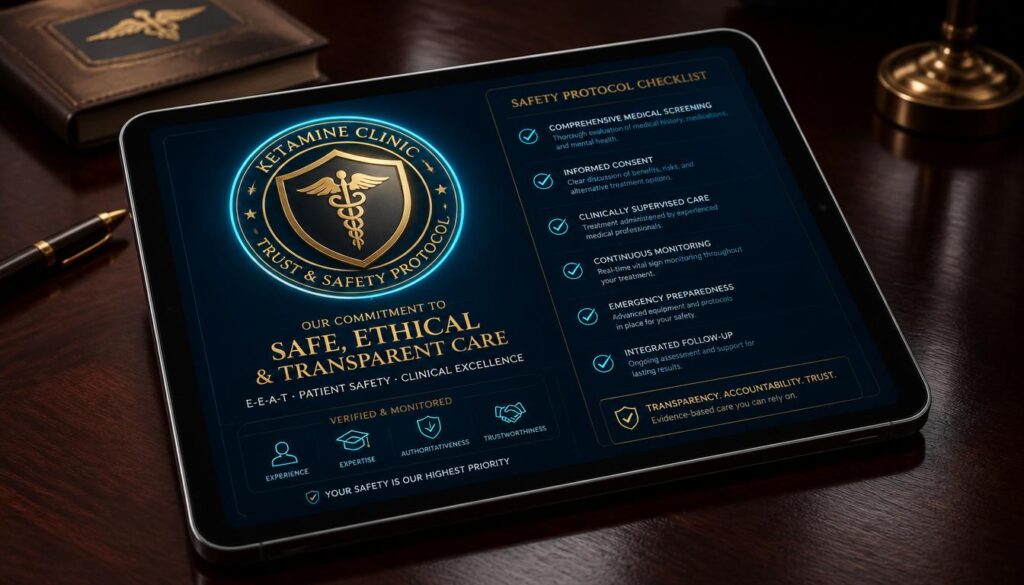
Because ketamine is a powerful anesthetic with a history of recreational association, establishing Experience, Expertise, Authoritativeness, and Trustworthiness (E-E-A-T) is paramount. Google holds medical websites to incredibly high standards under its “Your Money or Your Life” (YMYL) content guidelines, meaning that your clinic’s search rankings are directly tied to the verifiable expertise displayed on your pages. You must prominently feature the medical credentials, professional backgrounds, and board certifications of your clinical directors, anesthesiologists, psychiatrists, and nursing staff. Showing the real faces and qualifications of your medical team instantly mitigates the fear of the unknown.
Beyond displaying certificates, your website should detail the safety protocols and clinical environment of your physical office. Explaining who monitors the infusions, the exact equipment used for real-time vital tracking, and your medical team’s experience in handling adverse events helps patients feel physically secure before they ever step through your doors. Incorporating professional memberships in organizations like the American Society of Ketamine Physicians, Psychotherapists, and Practitioners (ASKP3) further reinforces your clinical legitimacy. Trust is the primary currency of psychedelic-assisted medicine, and a website that treats medical rigor as its foundation will naturally win the confidence of both patients and referring physicians.
What Essential Medical and Safety Information Should You Feature?
When individuals arrive at your website, one of their primary concerns is safety. You must directly address the question: is ketamine safe for depression? Your content should explain that when administered in a controlled, sub-anesthetic clinical setting by licensed professionals, ketamine is an incredibly safe and highly monitored intervention. By presenting the clinical evidence in an accessible manner, you can reassure patients that your protocols prioritize their physiological and psychological well-being above all else.
In addition to safety statistics, you must provide a balanced and transparent overview of potential ketamine therapy side effects. Detail how temporary physical sensations like mild dissociation, brief blood pressure elevation, lightheadedness, or nausea are normal and typically fade within an hour of completing the session. Providing an honest, comprehensive list of contraindications, such as active psychosis or uncontrolled cardiovascular conditions, shows that your clinic prioritizes patient safety over commercial gain. Transparently discussing these clinical realities on your website sets realistic expectations and filters out ineligible candidates before they schedule a consultation.
How Can You Clear Up Confusion About Ketamine Therapy Costs?
One of the biggest hurdles keeping interested patients from booking a session is financial uncertainty. Because intravenous infusions are rarely covered fully by major commercial insurance plans, you must address the topic of ketamine infusion cost openly and comprehensively. Keeping pricing hidden or hard to find can cause immediate frustration, driving highly qualified prospective patients to competitor websites that offer transparent figures. Your website should feature a dedicated financial page that breaks down individual session fees, package rates, and any available financing programs.
To capture search traffic from individuals actively budgeting for these life-changing treatments, you must optimize your financial content for terms like ketamine therapy for depression cost. Explain exactly what is included in your fees, such as pre-treatment medical screenings, personalized dosing preparation, active nursing supervision during the infusion, and post-session integration support. If your clinic provides superbills for potential out-of-network insurance reimbursement, explain that process in simple, step-by-step paragraphs. Providing this level of financial transparency reduces administrative friction and empowers patients to make informed decisions without feeling blindsided.
How Do You Educate Patients on What to Expect During a Session?
A patient’s anxiety often stems from a lack of concrete details regarding the actual treatment day. To alleviate these apprehensions, your website needs a dedicated “What to Expect” page that details the patient journey from arrival to discharge. Explain the preparation process, including fasting requirements and recommended comfortable clothing. Describe the physical room itself, emphasizing elements like dim lighting, noise-canceling headphones, comfortable recliners, and eye masks that promote a calm, introspective experience.
Your content must answer high-intent queries like what to expect during ketamine infusion by describing the physical and sensory changes that occur during the administration. Let patients know that they may feel a sense of weightlessness, mild dissociation, or visual shifts, but that a trained medical professional is always nearby to ensure comfort and safety. Additionally, explain how long does ketamine therapy last, detailing that while the active infusion usually takes around 40 minutes, patients should plan to spend about two hours at the clinic to allow for proper post-session recovery and monitoring. Laying out this timeline demystifies the procedure and makes the entire treatment feel manageable and structured.
Which Clinical Indications and Mental Health Conditions Should You Highlight?
To attract the exact patient populations your practice is best equipped to serve, your website should feature dedicated landing pages for specific mental health and chronic pain conditions. Instead of offering a single, generic page about ketamine, build specialized service pages that speak directly to the unique challenges of each condition. For example, a dedicated section on ketamine therapy for anxiety should describe how the compound works on glutamate receptors to rapidly interrupt the circular, exhausting loops of anxious thinking.
Similarly, creating a comprehensive page for ketamine therapy for PTSD allows you to speak directly to individuals suffering from trauma-induced hyperarousal and emotional numbness. Explain how ketamine promotes neuroplasticity, allowing patients to process traumatic memories with a sense of safety and distance. By writing highly focused, empathetic, and medically backed pages for treatment-resistant depression, bipolar depression, obsessive-compulsive disorder, and chronic pain, you construct a comprehensive resource library. This architecture signals to search engines that your clinic possesses deep, specialized expertise in treating these complex, intersecting conditions.

How Should You Address the Differences Between Administration Methods?
Because the landscape of ketamine-assisted medicine has expanded rapidly, modern consumers are highly researched and often confused by the varying modalities available. Your website must serve as an educational authority by clearly comparing the different routes of administration. A dedicated page or section comparing Spravato vs IV ketamine is highly effective for capturing search traffic from patients trying to choose between an FDA-approved intranasal spray and off-label intravenous therapy. Detail the differences in bioavailability, clinical setting requirements, insurance coverage, and overall efficacy to help users understand which path matches their clinical needs.
Furthermore, you should highlight how your clinic supports the psychological side of the healing process. If your practice incorporates psychotherapeutic support, explain the concept of ketamine assisted psychotherapy (KAP) and how it differs from standalone infusions. Describe how combining the neuroplastic window opened by ketamine with professional integration therapy helps patients lock in long-term behavioral changes and emotional breakthroughs. By presenting these comparisons objectively, you establish your clinic as an unbiased, patient-centered authority dedicated to helping individuals find the most effective treatment modality for their lives.
Why Is Patient-Centric Content and Empathetic Messaging the Secret to Conversions?
Many clinical websites make the mistake of using cold, overly clinical jargon that alienates individuals suffering from severe emotional pain. To build a highly converting digital presence, your copy must strike a balance between medical authority and profound empathy. Use compassionate, validating language that acknowledges how exhausting it is to live with treatment-resistant mental health conditions. Your writing should reflect that you see the patient as a whole person, not just a set of symptoms or a medical chart.
To reinforce this empathetic connection, feature real, authentic patient testimonials and success stories prominently on your homepage and treatment pages. Reading about another individual’s journey from profound despair to renewed hope can be the final piece of encouragement a hesitant visitor needs to take action. Ensure these stories are organized and presented respectfully, protecting patient privacy while highlighting the tangible, life-altering improvements in their daily quality of life. When clinical excellence is communicated through a lens of human warmth, prospective patients feel safe enough to reach out.
How Do You Optimize Your Site Structure for Local Search and Mobile Performance?
Even the most beautiful, informative website will fail to grow your practice if local patients cannot find it on search engines. To attract high-intent local traffic, your website must be optimized for geo-specific search terms like ketamine treatment near me. This involves setting up a logical site structure where your physical address, local phone number, and interactive Google Map are easily accessible in your website footer and on a dedicated contact page. If you operate multiple clinic locations, create unique, highly optimized location pages for each branch rather than grouping them all onto a single page.
Additionally, because the vast majority of mental health searches occur on smartphones, your website must feature flawless mobile responsiveness, rapid loading speeds, and intuitive navigation. A slow or clunky mobile site can cause frustrated users to bounce back to the search results page, which signals to Google that your site is not providing a high-quality user experience. Ensure that buttons are easy to tap, text is highly readable without zooming, and vital contact details are accessible in a single tap. Combining powerful local SEO tactics with an exceptional mobile user experience ensures that you capture local search intent precisely when patients are seeking immediate help.
What Simple Next Steps and Call-to-Actions (CTAs) Convert Skeptics Into Patients?
The ultimate goal of your website is to guide visitors toward taking action, but because of the nature of ketamine therapy, aggressive or high-pressure sales tactics will fail. Instead, utilize low-friction, supportive call-to-actions (CTAs) that invite visitors to take a gentle next step. Offer a free, confidential fifteen-minute phone consultation with a care coordinator so that anxious individuals can ask questions without feeling committed to an expensive treatment plan immediately.
Make these contact options incredibly easy to find by placing clear, contrasting CTA buttons in the top right corner of your navigation header, at the end of every educational page, and in a sticky mobile menu. You can also offer an online self-assessment quiz or a downloadable preparation guide to capture email leads from visitors who are still in the early research phase of their journey. By providing multiple, low-pressure pathways to connect with your staff, you create a welcoming, accessible digital environment that transforms interested visitors into loyal patients.