
What On-Page and Off-Page Factors Make a Home and Property Insurance Website Rank Higher on Google in More Competitive Markets?
Home and property insurance companies face intense competition online. Large national insurers dominate search results, while regional agencies and independent insurance providers compete for local visibility and qualified leads. Ranking higher on Google in competitive markets requires much more than simply adding keywords to a website.
Modern SEO for home insurance companies involves technical optimization, high-quality content, authority building, local trust signals, user experience improvements, and ongoing digital marketing efforts. Google evaluates hundreds of ranking factors when deciding which home and property insurance websites deserve top positions in search results.
For insurance brands operating in highly competitive areas, understanding both on-page SEO and off-page SEO factors is essential for long-term growth.
This guide explains the most important ranking factors that help property insurance companies improve visibility, generate organic traffic, and attract more qualified policyholders.
Why SEO Matters for Home and Property Insurance Companies
Home insurance is one of the most competitive industries online. Search terms like “home insurance quotes,” “property insurance company,” and “best homeowners insurance” are highly valuable because they often lead directly to policy sales.
Consumers usually research multiple providers before making decisions. They compare rates, coverage options, reviews, deductibles, and claims processes. This means insurance companies that appear prominently in Google search results gain more opportunities to capture leads early in the buying journey.
SEO helps home insurance companies:
- Increase organic website traffic
- Generate qualified insurance leads
- Build trust and authority
- Reduce reliance on paid advertising
- Improve local market visibility
- Strengthen brand recognition
- Increase policy quote requests
- Compete against national insurance brands
In highly competitive markets, strong SEO creates long-term visibility that continues producing leads over time.
What Are On-Page SEO Factors for Property Insurance Websites?
On-page SEO refers to everything directly optimized on the website itself. These elements help Google understand the website’s relevance, quality, authority, and user experience.
Keyword Optimization for Insurance Search Intent
One of the biggest mistakes property insurance websites make is targeting overly broad keywords without understanding search intent.
Successful home insurance SEO strategies target different stages of the customer journey.
Examples include:
Informational Keywords
These attract users researching insurance topics:
- How much home insurance do I need?
- What does homeowners insurance cover?
- Flood insurance vs homeowners insurance
- Property insurance deductible explained
Commercial Keywords
These target users comparing providers:
- Best home insurance companies
- Affordable homeowners insurance
- Property insurance providers near me
- Home insurance quotes online
Transactional Keywords
These target users ready to purchase:
- Buy home insurance
- Get homeowners insurance quote
- Property insurance consultation
- Home insurance agent near me
High-ranking insurance websites create content around all three search intent categories.
Optimized Title Tags and Meta Descriptions
Title tags remain one of the strongest on-page ranking factors.
A properly optimized insurance page title should:
- Include the primary keyword
- Mention the service location when applicable
- Stay under 60 characters
- Encourage clicks
Example:
“Home Insurance Company in Dallas, TX | Affordable Property Coverage”
Meta descriptions improve click-through rates from search results.
Effective descriptions should:
- Include target keywords naturally
- Explain benefits clearly
- Mention trust factors
- Encourage action
Example:
“Compare affordable home and property insurance coverage options in Dallas. Get personalized homeowners insurance quotes from experienced local agents.”
Higher click-through rates can improve organic search performance over time.
High-Quality Content for Home Insurance Consumers
Google rewards insurance websites that publish genuinely useful content.
Thin pages with little information rarely rank well in competitive markets.
Strong home insurance content should:
- Answer common consumer questions
- Explain complex insurance topics clearly
- Provide practical guidance
- Include local market insights
- Demonstrate expertise
Examples of strong insurance content include:
- Homeowners insurance guides
- Claims process explanations
- Storm damage insurance resources
- State-specific insurance requirements
- Property risk prevention tips
- Coverage comparison articles
Long-form educational content often performs especially well for property insurance SEO.
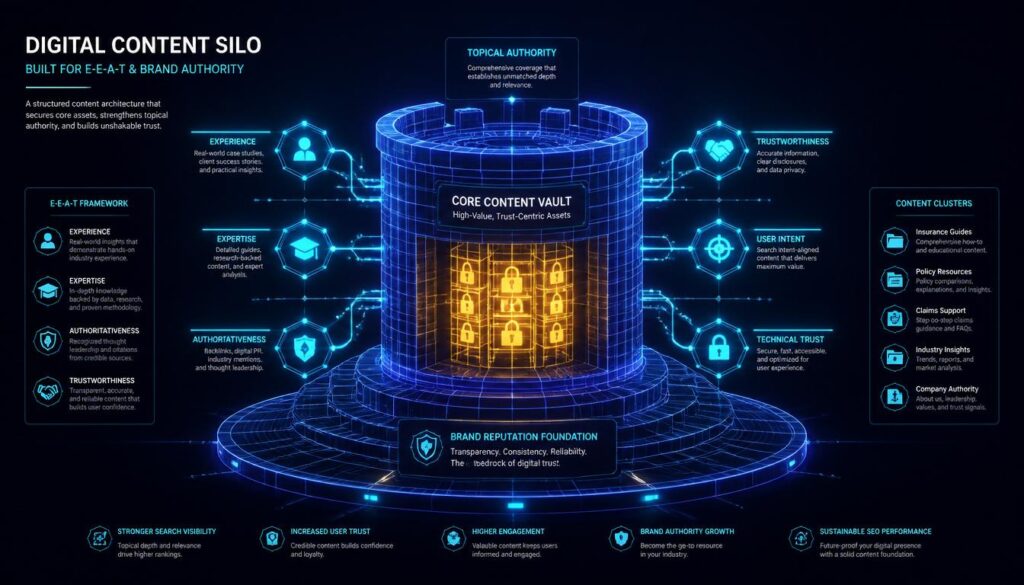
E-E-A-T Signals for Insurance Websites
Google places high importance on E-E-A-T:
- Experience
- Expertise
- Authoritativeness
- Trustworthiness
This is especially important in insurance because it falls under Google’s “Your Money or Your Life” content category.
Insurance websites should clearly demonstrate expertise by including:
- Licensed insurance professionals
- Author bios
- Certifications
- Industry affiliations
- Years of experience
- Real-world claims knowledge
Strong E-E-A-T signals help property insurance websites compete more effectively against larger national brands.
Internal Linking Structure
Internal links help Google understand website hierarchy and relationships between pages.
A strong internal linking strategy improves crawlability and distributes authority throughout the site.
Examples include linking:
- Blog articles to service pages
- Local pages to quote request pages
- Educational content to coverage pages
- Claims resources to contact pages
Insurance websites with organized internal linking often see better indexing and stronger rankings.
Location-Based Landing Pages
Competitive property insurance markets require local SEO optimization.
Instead of relying on one generic service page, successful insurance websites create individual pages for each target market.
Examples include:
- Home Insurance in Houston
- Property Insurance in Miami
- Homeowners Insurance in Phoenix
- Condo Insurance in Atlanta
Each page should contain:
- Unique localized content
- Local risk information
- Area-specific insurance concerns
- Community references
- Local testimonials
Avoid duplicate content across city pages because Google may view this as low quality.
Website Speed and Core Web Vitals
Fast-loading websites rank better and convert more visitors.
Google evaluates Core Web Vitals including:
- Loading speed
- Interactivity
- Visual stability
Insurance websites often become slow due to:
- Large images
- Excessive scripts
- Poor hosting
- Third-party quote tools
Improving page speed can significantly improve rankings and user engagement.
Ways to improve speed include:
- Compressing images
- Using modern hosting
- Reducing unnecessary plugins
- Enabling caching
- Minimizing JavaScript
Mobile performance is especially important because many insurance consumers search on smartphones.
Mobile-Friendly Design
Google primarily uses mobile-first indexing.
A property insurance website must function smoothly on all devices.
Mobile optimization includes:
- Responsive design
- Fast mobile loading
- Easy navigation
- Clickable phone numbers
- Readable text sizes
- Simple forms
Poor mobile experiences often lead to higher bounce rates and lower rankings.
Optimized URL Structure
Simple, keyword-focused URLs help both users and search engines.
Examples of good insurance URLs:
- /home-insurance-dallas
- /property-insurance-florida
- /homeowners-insurance-quotes
Avoid complicated URLs with unnecessary parameters or numbers.
Clean URL structures improve crawlability and usability.
Schema Markup for Insurance Companies
Structured data helps Google better understand insurance websites.
Useful schema types include:
- Local business schema
- FAQ schema
- Review schema
- Service schema
- Organization schema
Schema markup can improve search visibility and increase click-through rates by enhancing search result appearance.
Image Optimization
Images support user experience and SEO when properly optimized.
Insurance websites should:
- Compress images
- Add descriptive alt text
- Use relevant file names
- Include locally relevant visuals
Example alt text:
“Homeowners insurance agent assisting family in Houston TX”
Optimized images help improve accessibility and search visibility.
Conversion-Focused User Experience
Google increasingly evaluates user engagement signals.
Websites that satisfy users often perform better in search rankings.
Insurance websites should prioritize:
- Clear calls to action
- Easy quote request forms
- Trust badges
- Customer reviews
- Transparent contact information
- Live chat options
A strong user experience can increase time on site and reduce bounce rates.
Fresh Content Updates
Google favors websites that stay updated.
Insurance regulations, market conditions, and coverage trends change regularly.
Home insurance companies should routinely update:
- Service pages
- Blog content
- State regulations
- Policy information
- Claims resources
Updated content signals ongoing relevance and expertise.

What Are Off-Page SEO Factors for Insurance Websites?
Off-page SEO refers to signals outside the website that influence rankings.
For competitive insurance markets, off-page authority is often the deciding factor between page one rankings and obscurity.
High-Quality Backlinks
Backlinks remain one of the strongest ranking signals.
When reputable websites link to a home insurance website, Google interprets this as a vote of confidence.
Strong backlink sources include:
- News websites
- Local publications
- Industry organizations
- Financial blogs
- Real estate websites
- Home improvement publications
Insurance websites with authoritative backlink profiles usually rank better in competitive search results.
Digital PR Campaigns
Digital PR has become essential for insurance SEO.
Successful home insurance digital PR campaigns often include:
- Storm preparedness studies
- Housing market reports
- Insurance claims statistics
- Natural disaster insights
- Home safety surveys
These campaigns attract backlinks from journalists and publishers.
For example, a property insurance company might release data about the most common storm damage claims in Texas. Local news websites may then link back to the report.
This improves domain authority and search visibility.
Local Citations and Directory Listings
Consistency across local business listings helps strengthen local SEO.
Important directories include:
- Google Business Profile
- Yelp
- Bing Places
- Apple Maps
- Insurance directories
- Chamber of commerce listings
Insurance companies should maintain consistent:
- Business name
- Address
- Phone number
- Website URL
Inconsistent listings can weaken local ranking signals.
Google Business Profile Optimization
Google Business Profile is critical for local insurance SEO.
Optimized profiles include:
- Accurate categories
- Service descriptions
- Photos
- Reviews
- Updated hours
- Local posts
Insurance agencies with active and optimized profiles often rank better in map results.
Online Reviews and Reputation Management
Reviews strongly influence both rankings and conversions.
Positive reviews improve trust and local search visibility.
Insurance companies should actively request reviews from satisfied clients after:
- Policy purchases
- Claims assistance
- Renewals
- Customer support interactions
Responding professionally to reviews also helps strengthen trust signals.
Social Media Signals and Brand Visibility
Social media does not directly impact rankings in the same way backlinks do, but it contributes to visibility and engagement.
Insurance companies that regularly share educational content can:
- Increase brand awareness
- Generate referral traffic
- Earn backlinks naturally
- Improve audience engagement
Strong social media visibility often supports broader SEO efforts.
Brand Mentions Across the Web
Google increasingly recognizes brand authority even without direct links.
Mentions of an insurance company across:
- News articles
- Podcasts
- Forums
- Community websites
- Industry blogs
can strengthen trust and authority signals.
Consistent brand visibility helps establish market credibility.
Content Marketing and Link Attraction
Publishing valuable content consistently is one of the best long-term SEO strategies.
Examples of high-performing insurance content include:
- Home maintenance checklists
- Hurricane preparedness guides
- Insurance cost calculators
- Seasonal property protection tips
- Interactive coverage resources
Helpful content naturally attracts backlinks and shares over time.
Local Partnerships and Sponsorships
Community involvement can support off-page SEO.
Insurance companies can earn valuable local backlinks through:
- Charity sponsorships
- Community events
- Local business partnerships
- School sponsorships
- Real estate collaborations
These local signals help strengthen geographic relevance.
Media Outreach
Insurance experts can earn authoritative backlinks by contributing expert commentary to journalists.
Topics may include:
- Natural disasters
- Insurance trends
- Property risks
- Housing market conditions
- Claims advice
Media outreach builds authority and improves brand visibility.
Competitor Link Gap Analysis
Competitive insurance SEO often involves identifying backlink opportunities competitors already use.
SEO teams analyze:
- Competitor referring domains
- Guest posting opportunities
- Local partnerships
- Industry directories
- News coverage sources
Closing backlink gaps can improve competitive positioning.

Behavioral Signals That Influence Rankings
Google also evaluates user behavior patterns.
Important engagement metrics include:
- Click-through rate
- Bounce rate
- Time on site
- Pages per session
- Return visits
Insurance websites that provide valuable user experiences often perform better over time.
Technical SEO Factors for Competitive Insurance Markets
Technical SEO ensures Google can properly crawl and index the website.
Even strong content may struggle without technical optimization.
Crawlability and Indexing
Insurance websites should ensure:
- XML sitemaps are updated
- Broken links are fixed
- Important pages are indexable
- Duplicate content is minimized
Technical issues can prevent valuable pages from ranking.
HTTPS Security
Google prioritizes secure websites.
Insurance websites collect sensitive user information, making HTTPS essential for both SEO and trust.
Secure websites help improve user confidence during quote requests.
Structured Site Architecture
Large insurance websites should organize content logically.
Examples include:
- /home-insurance/
- /flood-insurance/
- /condo-insurance/
- /claims/
- /resources/
Strong architecture improves user navigation and search engine crawling.
Canonical Tags and Duplicate Content Control
Insurance websites often create similar pages for multiple cities or services.
Canonical tags help prevent duplicate content issues.
Unique localized content is still essential for competitive rankings.
Common SEO Mistakes Property Insurance Companies Make
Many insurance companies struggle because they focus on outdated tactics.
Common SEO mistakes include:
- Keyword stuffing
- Thin content
- Duplicate city pages
- Slow websites
- Ignoring mobile users
- Poor backlink quality
- Weak local SEO
- Infrequent content updates
Avoiding these issues can significantly improve long-term performance.
Why Competitive Markets Require Stronger SEO Strategies
In smaller markets, basic SEO may produce decent results.
Competitive cities require much more advanced strategies because national insurance companies invest heavily in digital marketing.
To compete effectively, local and regional insurance companies must focus on:
- Superior content quality
- Local expertise
- Strong authority signals
- Better user experience
- Consistent content publishing
- Digital PR campaigns
- Local trust building
The combination of strong on-page and off-page SEO creates sustainable competitive advantages.
How Long Does Insurance SEO Take?
SEO for home and property insurance is highly competitive.
Results usually take time because Google evaluates authority and trust gradually.
Typical timelines include:
- 3 to 6 months for early improvements
- 6 to 12 months for meaningful traffic growth
- 12+ months for strong competitive rankings
Long-term consistency is essential.
Insurance companies that continue investing in SEO usually outperform competitors relying only on short-term advertising.
Why Content Quality Matters More Than Ever
Google’s algorithms increasingly prioritize content usefulness.
Insurance companies should avoid publishing low-value content solely for keyword targeting.
Instead, focus on creating resources that genuinely help consumers understand:
- Coverage options
- Claims processes
- Property risks
- Policy comparisons
- Cost factors
- Home protection strategies
High-quality content improves rankings, backlinks, engagement, and conversions simultaneously.
The Role of Trust in Insurance SEO
Trust is one of the most important ranking factors in insurance marketing.
Consumers want reassurance before sharing personal information or purchasing policies.
Trust signals include:
- Customer reviews
- Professional certifications
- Transparent pricing information
- Secure websites
- Real contact information
- Educational resources
- Clear policy explanations
Websites that establish trust effectively tend to convert more traffic into leads and sales.
Combining SEO With Broader Digital Marketing
SEO works best when integrated with broader digital marketing efforts.
Successful home insurance brands often combine SEO with:
- Content marketing
- Social media marketing
- Email marketing
- Digital PR
- Video marketing
- Reputation management
These channels reinforce authority and visibility across the web.