
How Do Content Silos Built Around State Specific Underwriting Rules Drive Organic Auto Insurance Sales?
Auto insurance companies operate in one of the most competitive digital markets online. National brands, regional carriers, independent agencies, and comparison websites all compete for visibility in search engines and AI-driven search experiences. One of the most effective SEO strategies for increasing organic auto insurance sales is building content silos around state specific underwriting rules.
A content silo is a structured group of interconnected pages focused on a highly specific topic. For auto insurance companies, state-focused silos help organize content around underwriting requirements, coverage laws, risk factors, policy limitations, pricing variables, and compliance standards unique to each state. These silos improve topical authority, help search engines better understand relevance, and attract highly qualified users searching for local insurance information.
State-specific underwriting content also aligns closely with how consumers search for auto insurance. Drivers often want answers about minimum liability limits, no-fault laws, SR-22 requirements, high-risk driver rules, uninsured motorist coverage, DUI impacts, weather-related risk factors, and state-specific rate calculations. When insurance websites build comprehensive content ecosystems around these topics, they create stronger search visibility and improve conversion rates.
For auto insurance companies, this strategy delivers multiple benefits:
- Better rankings for local and state-level insurance searches
- Increased trust from consumers researching policy requirements
- Higher conversion rates from informational search traffic
- Stronger topical authority for Google AI Overviews
- Improved internal linking structures
- Greater visibility for long-tail underwriting-related keywords
- More opportunities to rank for localized auto insurance queries
This article explains how content silos built around underwriting rules help auto insurance companies drive organic traffic, generate qualified leads, and increase policy sales through SEO-focused content marketing.
Why State Specific Content Matters for Auto Insurance SEO
Auto insurance is regulated at the state level. Coverage requirements, underwriting restrictions, liability minimums, and claims regulations vary significantly across the United States. Because of this, search behavior also becomes highly localized.
Drivers searching for insurance information rarely search only for “auto insurance.” Instead, they use localized search phrases such as:
- Texas minimum liability coverage
- Florida no-fault auto insurance rules
- California high-risk driver insurance
- SR-22 insurance requirements in Illinois
- Best auto insurance for teen drivers in Georgia
These searches reveal strong purchase intent. Users are often actively comparing quotes, researching coverage requirements, or preparing to buy policies.
Auto insurance companies that create detailed state-specific content can capture this traffic more effectively than websites relying only on broad national pages.
Search engines also prioritize relevance. A page specifically discussing underwriting factors for Michigan drivers has a higher chance of ranking for Michigan insurance searches than a generic nationwide page.
This localized relevance is one reason state-specific content silos are becoming essential for insurance SEO strategies.
What Are Content Silos in Insurance SEO?
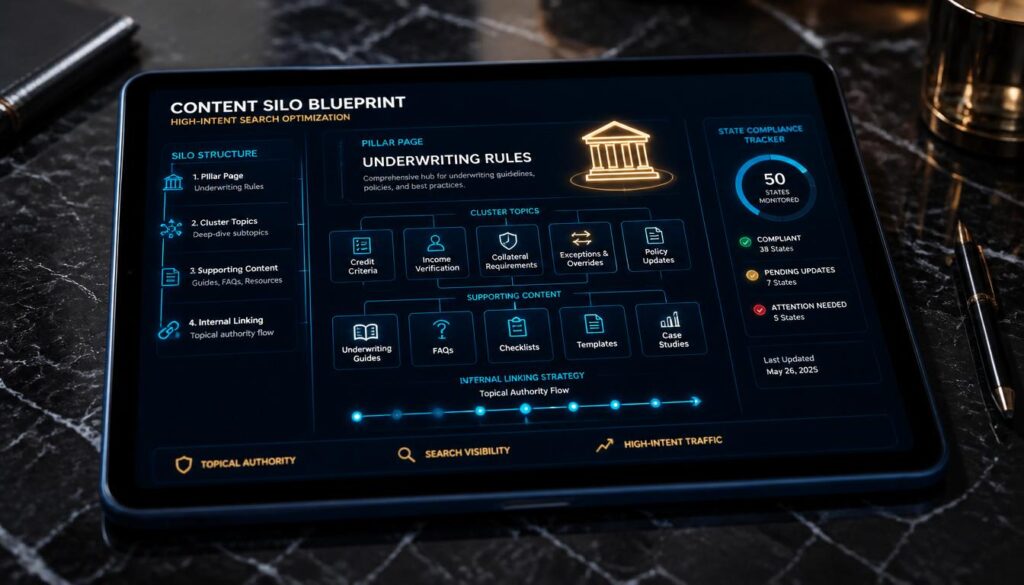
A content silo is a structured collection of pages centered around a core topic. In the insurance industry, silos help organize large amounts of information into clear topical categories.
For example, an auto insurance company may create a main state hub page such as:
- Auto Insurance in Florida
That hub can then internally link to supporting pages like:
- Florida No-Fault Insurance Rules
- Minimum Coverage Requirements in Florida
- Florida Hurricane Risk and Auto Insurance Rates
- Florida SR-22 Insurance Guide
- How Florida Underwriting Rules Affect Premiums
- Best Auto Insurance for Florida Teen Drivers
This structure signals strong topical authority to search engines.
Instead of isolated blog posts competing against each other, the pages reinforce one another through strategic internal linking and semantic relevance.
For auto insurance companies, this creates a scalable SEO framework capable of supporting thousands of localized keywords.
How Underwriting Rules Create High-Intent Search Opportunities
Underwriting rules directly influence how insurers evaluate risk. Consumers affected by these rules often search online for explanations before requesting quotes.
This creates powerful organic search opportunities.
Examples include:
High-Risk Driver Rules
Many drivers search for insurance after accidents, DUIs, speeding tickets, or license suspensions. Searches may include:
- Best auto insurance after DUI in Arizona
- High-risk auto insurance in Nevada
- Cheap SR-22 insurance in Ohio
These users are often ready to purchase immediately.
Weather and Catastrophe Risk
Certain states face unique environmental risks that affect underwriting.
Examples include:
- Hurricane-related risk in Florida
- Hail damage exposure in Texas
- Wildfire risk in California
- Flood-prone areas in Louisiana
Content explaining how these risks influence auto insurance rates helps attract highly targeted traffic.
State Liability Requirements
Drivers frequently search for state minimum coverage laws.
Examples include:
- Minimum liability insurance in New Jersey
- Required uninsured motorist coverage in Maryland
- New York no-fault insurance explained
These searches are highly relevant to policy purchasing decisions.
Teen Driver Regulations
States may have different graduated licensing systems and underwriting guidelines for young drivers.
Auto insurance companies can build content around:
- Teen driver insurance laws
- Good student discounts
- Parent policy underwriting rules
- Driver training impacts on premiums
This content often performs well because parents actively research insurance costs during the buying process.
Why Content Silos Improve Organic Rankings
Search engines increasingly evaluate websites based on topical authority rather than individual keyword optimization alone.
A well-built state underwriting silo demonstrates expertise and depth.
For example, if an insurance website publishes 25 interconnected pages about California auto insurance underwriting, Google can more confidently associate the site with California insurance expertise.
This improves rankings across many related keywords.
Strong silos also improve:
Internal Linking
Strategic internal links distribute authority throughout the site.
Hub pages can pass ranking power to supporting pages, while supporting pages reinforce the authority of the main state page.
Crawl Efficiency
Well-structured silos make it easier for search engines to discover and index content.
This becomes especially important for large insurance websites containing thousands of pages.
User Experience
Drivers can navigate related topics more easily.
Someone researching SR-22 insurance may also need information about minimum liability coverage or reinstatement requirements.
Silo structures naturally guide users deeper into the website.
Engagement Signals
Better organization often increases time on site, page views, and overall engagement.
These behavioral signals can indirectly support SEO performance.
The Role of Long-Tail Keywords in Auto Insurance Sales
Long-tail keywords are highly specific search phrases with lower search volume but stronger intent.
Examples include:
- Cheapest auto insurance for DUI drivers in Texas
- Florida no-fault insurance explained for new residents
- California rideshare insurance underwriting rules
- How speeding tickets affect insurance rates in Georgia
These searches often convert better than broad keywords because the user already understands their needs.
Content silos allow auto insurance companies to target hundreds or thousands of these long-tail searches efficiently.
Instead of competing only for expensive national keywords like “auto insurance,” insurers can dominate niche local queries with less competition and higher conversion potential.

How State Specific Silos Support Google AI Overviews
AI-driven search experiences increasingly reward detailed, structured, authoritative content.
Google AI Overviews frequently summarize content that clearly explains regulations, requirements, and comparisons.
State underwriting silos naturally fit this format because they provide:
- Detailed explanations
- Structured topic clusters
- Clear FAQ sections
- Legal and regulatory context
- Location relevance
- Consumer guidance
Auto insurance companies that build comprehensive state-specific ecosystems are more likely to appear in AI-generated summaries.
This visibility can significantly increase organic traffic.
Best Practices for Building Auto Insurance Content Silos
Start With State Hub Pages
Each state should have a primary landing page targeting broad state-level insurance keywords.
Examples include:
- Auto Insurance in Texas
- California Car Insurance Guide
- Florida Auto Coverage Requirements
These pages should provide overview information and link to supporting content.
Build Supporting Underwriting Pages
Supporting pages should address specific underwriting factors.
Examples include:
- DUI underwriting rules
- Teen driver risk assessments
- Credit score impacts
- Weather-related claims risk
- Commercial vehicle classifications
- Multi-driver household rules
The goal is topical depth.
Use Consistent Internal Linking
Every supporting page should link back to the hub page and to related articles within the silo.
This creates strong semantic relationships.
Optimize for Local Search Intent
Use state names naturally throughout:
- Headers
- Meta titles
- URLs
- FAQs
- Internal links
Localized SEO improves relevance for state-specific searches.
Add FAQs
FAQ sections capture conversational queries and voice search traffic.
Examples include:
- Why is auto insurance more expensive in Michigan?
- Does Florida require uninsured motorist coverage?
- How long does a DUI affect insurance rates in Texas?
These sections can also increase eligibility for featured snippets and AI summaries.
Why This Strategy Generates Better Leads
Not all traffic converts equally.
Broad informational traffic may generate page views without policy sales. However, underwriting-focused searches often come from consumers actively evaluating insurance options.
Someone searching:
- “SR-22 insurance requirements in Indiana”
is much closer to purchasing than someone searching:
- “What is auto insurance?”
This makes underwriting content especially valuable for lead generation.
Users arriving through these searches often:
- Need immediate coverage
- Have complex insurance situations
- Require specialized underwriting
- Need state compliance information
- Are actively comparing providers
As a result, conversion rates tend to be higher.
Competitive Advantages for Regional Auto Insurance Companies
Large national brands often create generalized content at scale. This creates opportunities for regional auto insurance companies to compete more effectively through localized expertise.
A regional insurer can build:
- More detailed state guides
- Better local underwriting explanations
- More region-specific examples
- Stronger local trust signals
This often helps smaller insurers outrank larger competitors for localized searches.
Regional expertise becomes a major SEO advantage.
How Insurance Agencies Can Use This Strategy
Independent insurance agencies can also benefit from underwriting silos.
Agencies can create content around:
- State insurance laws
- Carrier underwriting differences
- Regional driving risks
- Local accident trends
- Vehicle theft statistics
- Weather exposure
This helps agencies attract organic traffic without relying entirely on paid advertising.
Local agencies can also personalize content with regional expertise that national comparison websites may lack.

Common Mistakes Auto Insurance Companies Should Avoid
Thin State Pages
Many insurance websites create low-quality state pages with only minor wording changes.
Search engines increasingly recognize this as weak content.
Each state page should include genuinely unique information.
Poor Internal Linking
Without strong internal links, silos lose much of their SEO value.
Pages should connect naturally across related underwriting topics.
Ignoring User Intent
Content should answer real consumer questions rather than simply targeting keywords.
Helpful, informative content performs better long term.
Overlooking Mobile Experience
Most insurance research happens on mobile devices.
Fast-loading pages, readable formatting, and clear navigation are essential.
Measuring the Success of Underwriting Content Silos
Auto insurance companies should monitor several SEO metrics:
Organic Traffic Growth
Track increases in state-level search traffic.
Keyword Rankings
Measure rankings for underwriting-related search phrases.
Conversion Rates
Monitor quote requests, calls, and policy applications from organic visitors.
Engagement Metrics
Review bounce rates, time on page, and internal navigation behavior.
AI Visibility
Track appearance in AI Overviews and featured snippets.
These metrics help insurers refine and expand their content strategies.
The Future of Auto Insurance SEO
Search behavior continues shifting toward conversational and highly specific queries.
Consumers increasingly expect detailed answers tailored to their location and situation.
As AI search evolves, generic insurance content will become less competitive.
Auto insurance companies that invest in comprehensive state underwriting silos now will likely gain long-term SEO advantages.
The future belongs to insurers that combine:
- Local expertise
- Technical underwriting knowledge
- Strong SEO architecture
- Helpful educational content
- AI-friendly formatting
- State-specific relevance
This strategy not only improves rankings but also creates more qualified organic traffic capable of driving real policy sales.