
How Does Building Topical Authority Around Car Accident Claims Procedures Lower Total Marketing Cost For Auto Insurers in the US?
Many auto insurance companies spend millions of dollars each year on paid advertising, lead generation platforms, and customer acquisition campaigns. While these channels can generate policy sales, they often come with rising costs and increasing competition. Building topical authority around car accident claims procedures offers an alternative strategy that can significantly reduce total marketing costs while increasing qualified traffic, brand trust, and policyholder acquisition.
When auto insurers create comprehensive content covering every aspect of the car accident claims process, they become a trusted source of information for consumers searching online after an accident. This approach helps insurance companies rank for thousands of relevant search terms, generate consistent organic traffic, improve visibility in AI-powered search experiences, increase conversion rates, and reduce dependence on expensive advertising channels.
Instead of paying for every website visitor through PPC campaigns, insurers can attract prospects organically by answering the exact questions drivers have during the claims process. Over time, this content asset compounds in value, producing leads and policy opportunities long after publication. As a result, many auto insurance companies are investing in topical authority strategies to lower customer acquisition costs and build sustainable marketing advantages.
Why Car Accident Claims Content Attracts High-Intent Traffic
One of the biggest reasons topical authority lowers marketing costs is that car accident claims content naturally attracts high-intent users.
After an accident, drivers immediately begin searching for answers. They want to know:
- What to do after a car accident
- How to file an insurance claim
- How fault is determined
- What evidence is needed
- How long claims take
- How settlement negotiations work
- Whether their insurance covers damages
These searches often occur at moments when consumers are highly engaged and actively evaluating insurance companies.
Unlike broad searches such as “best auto insurance” or “cheap car insurance,” claims-related searches are often tied to immediate needs. This means visitors arriving through claims content are frequently more qualified and more likely to convert into future customers.
When an insurer consistently provides helpful answers throughout the claims journey, it builds trust before a prospect even requests a quote.
Understanding Topical Authority in Auto Insurance
Topical authority refers to the depth and breadth of content coverage around a specific subject area. Search engines increasingly reward websites that comprehensively address a topic rather than publishing isolated articles. Comprehensive content clusters, internal linking, and extensive topic coverage help establish expertise and improve rankings.
For auto insurance companies, topical authority around car accident claims procedures means creating content that covers every stage of the claims process.
Examples include:
- Accident scene documentation
- Filing insurance claims
- State-specific accident reporting laws
- Medical injury claims
- Property damage claims
- Rental vehicle reimbursement
- Uninsured motorist claims
- Total loss claims
- Settlement negotiations
- Claim disputes
- Litigation procedures
Instead of producing a handful of generic articles, insurers create interconnected content hubs that answer virtually every question consumers may ask.
This comprehensive approach signals expertise to search engines while creating a better experience for users.

Reducing Dependence on Paid Advertising
One of the most direct ways topical authority lowers marketing costs is by reducing dependence on paid traffic.
The auto insurance industry is known for some of the most competitive advertising costs online. Keywords related to car insurance, accident claims, and insurance quotes often command extremely high CPC rates.
Many insurers rely heavily on:
- Google Ads
- Display advertising
- Social media advertising
- Lead generation networks
- Comparison websites
While these channels can produce results, they require continuous spending.
Organic traffic generated through topical authority operates differently.
Once a claims article ranks well in search results, it can generate visitors for months or even years without additional advertising costs. Strong topical coverage can help websites rank for more related keywords while reducing reliance on broader authority signals alone.
This shifts marketing investment from recurring media expenses toward long-term content assets.
Building Trust Before Consumers Request Quotes
Trust plays a major role in insurance purchasing decisions.
Consumers often view insurance products as complicated and difficult to understand. They want reassurance that an insurer will help them during stressful situations.
Car accident claims content creates trust because it addresses consumers when they need guidance most.
A driver involved in an accident may search dozens of questions over several days or weeks. If the same insurer consistently provides useful answers, that insurer becomes a familiar and trusted resource.
By the time the consumer shops for a new policy or considers switching providers, that trust can influence purchasing decisions.
This reduces the amount of marketing effort required to convince prospects to take action.
Improving Conversion Rates Across the Funnel
Topical authority doesn’t simply generate traffic.
It also improves conversion efficiency.
Visitors who consume multiple pieces of claims-related content tend to become more educated and more confident in the insurer’s expertise.
These users often:
- Spend more time on the website
- Visit more pages
- Engage with calculators and tools
- Download resources
- Request quotes
- Contact agents
Because they are already informed, they often require less persuasion than cold advertising traffic.
Higher conversion rates mean insurers can generate more policy sales from the same amount of traffic, effectively lowering acquisition costs.
Capturing Thousands of Long-Tail Search Queries
Many insurance marketers focus on highly competitive keywords.
However, some of the most valuable opportunities exist in long-tail searches.
Examples include:
- How long does a rear-end collision claim take
- What happens if the other driver has no insurance
- Can I file a claim after a hit and run accident
- How is fault determined in a parking lot accident
- What documents are needed for an insurance claim
Individually, these keywords may have modest search volume.
Collectively, they represent enormous traffic potential.
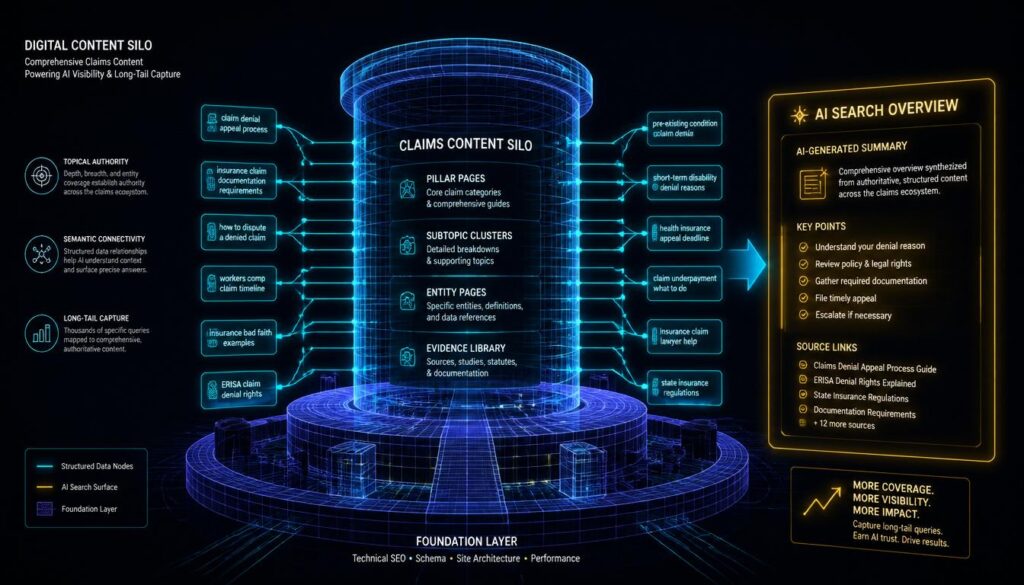
Sites with strong topical authority often rank for a broad range of related searches because search engines recognize comprehensive topic coverage. Topic clusters and interconnected content structures help websites gain visibility across many related queries.
This allows auto insurance companies to capture traffic that competitors frequently overlook.
Supporting AI Search Visibility
AI-powered search experiences are changing how consumers find information.
Platforms increasingly prioritize sources that demonstrate expertise and comprehensive topic coverage.
When auto insurers build extensive content around accident claims procedures, they increase the likelihood of appearing in:
- AI Overviews
- Conversational search results
- AI-generated answers
- Voice search responses
Topical authority has become increasingly important for AI visibility because AI systems often favor sources with deep subject matter expertise and extensive content coverage.
This creates additional traffic opportunities without increasing advertising budgets.
Lowering Cost Per Acquisition Over Time
Customer acquisition cost is one of the most important metrics for auto insurance companies.
Paid advertising produces immediate traffic but usually generates ongoing costs.
Content marketing works differently.
The initial investment includes:
- Keyword research
- Content creation
- Expert review
- Publishing
- Optimization
After publication, however, the content continues attracting visitors.
As rankings improve and traffic grows, the cost per acquisition often declines because the original investment is spread across a growing number of leads and policyholders.
Over time, insurers may see:
- Lower acquisition costs
- Higher marketing efficiency
- Better return on investment
- Reduced dependency on media spending
This is one reason content-driven growth strategies are becoming increasingly attractive in competitive insurance markets.
Creating a Self-Reinforcing Content Ecosystem
Topical authority creates compounding benefits.
Each new claims article strengthens existing content through internal linking and topical relevance.
For example:
A pillar page about car accident claims may link to articles covering:
- Accident reporting requirements
- Medical claim procedures
- Property damage claims
- Settlement negotiations
- State-specific regulations
As the content network expands, search engines gain a stronger understanding of the insurer’s expertise. Internal linking and content clusters help distribute authority throughout a website while reinforcing topic relationships.
This often leads to improved rankings across the entire content ecosystem.
The result is a marketing asset that becomes more valuable over time.
Enhancing State-Specific Marketing Efforts
Insurance regulations vary significantly across states.
Consumers often search for information related to their local jurisdiction.
Examples include:
- California accident claim deadlines
- Texas comparative negligence rules
- Florida no-fault insurance claims
- New York accident reporting requirements
Auto insurers that create state-specific claims content can capture highly targeted local traffic.
These visitors are often more qualified because the content directly addresses their situation.
State-level content also supports local SEO initiatives and helps insurers compete more effectively in regional markets.

Improving Customer Retention
Topical authority can reduce marketing costs beyond new customer acquisition.
Claims-related content also improves customer retention.
Existing policyholders frequently seek information after accidents.
If the insurer’s website provides clear guidance throughout the claims process, policyholders experience less frustration and uncertainty.
Better customer experiences can contribute to:
- Higher satisfaction
- Greater loyalty
- Increased renewals
- More referrals
Retaining customers is generally less expensive than acquiring new ones, making this an important cost-saving benefit.
Generating More Referral Traffic and Backlinks
High-quality claims content often attracts links from:
- Legal websites
- Consumer resources
- News organizations
- Automotive blogs
- Government resources
These backlinks can strengthen overall SEO performance and improve rankings across the insurer’s website.
As authority grows, organic traffic often expands beyond the claims content itself.
This creates additional marketing efficiencies and reduces reliance on paid acquisition channels.
Building a Sustainable Competitive Advantage
Advertising advantages can disappear quickly.
Competitors can increase bids, copy campaigns, or outspend rivals.
Topical authority is more difficult to replicate.
Building comprehensive content coverage around car accident claims procedures requires:
- Research
- Expertise
- Strategic planning
- Ongoing content development
Many insurers struggle to maintain the consistency required to dominate an entire topic area.
Companies that successfully establish topical authority often create barriers that competitors cannot easily overcome.
This long-term advantage contributes to lower marketing costs and more stable lead generation.
Measuring the Financial Impact
Auto insurers should track specific metrics to evaluate the impact of topical authority initiatives.
Key metrics include:
- Organic traffic growth
- Claims-related keyword rankings
- AI search visibility
- Quote request volume
- Customer acquisition cost
- Cost per lead
- Conversion rates
- Policy sales from organic traffic
- Customer retention rates
Over time, successful topical authority programs typically show increasing organic traffic and decreasing acquisition costs.
These improvements demonstrate how content investments generate lasting returns.