
How Can Medical Practices Improve Their Google Business Profile Rankings
Why Google Business Profile Matters For Medical Practices
When patients search online for doctors, clinics, dentists, urgent care centers, or healthcare specialists, they often see local map listings before traditional website results. These local listings come from Google Business Profile, formerly known as Google My Business. For medical practices, appearing in these local search results can directly impact patient calls, appointment requests, and long-term practice growth.
Many patients now search for healthcare providers using phrases like “family doctor near me,” “best orthopedic surgeon in Dallas,” or “urgent care open now.” Google uses location-based ranking factors to determine which practices appear in the local map pack. If your medical practice has a well-optimized Google Business Profile, you have a much better chance of being discovered by nearby patients.
Strong Google Business Profile rankings can help medical practices build trust quickly. Patients can immediately see reviews, office hours, contact details, photos, directions, and even appointment links. This makes the decision-making process easier and helps practices attract more local traffic.
Claim And Verify Your Google Business Profile
The first step to improving rankings is claiming and verifying your Google Business Profile. Some medical practices already have automatically generated listings on Google, but these profiles may contain outdated or incorrect information.
By claiming your listing, you gain control over your practice information. Verification also signals legitimacy to Google. A verified business profile is more likely to rank well than an incomplete or unverified listing.
Medical practices should ensure that the profile belongs to the correct practice location. Multi-location healthcare groups should create separate listings for each office instead of combining them into one profile.
Verification usually happens through mail, phone, email, or video verification. Once verified, practices can begin optimizing every section of the profile.
Use Accurate And Consistent Business Information
Consistency is one of the most important local SEO ranking factors. Your practice name, address, and phone number should match everywhere online, including your website, social media profiles, healthcare directories, and insurance listings.
Even small inconsistencies can confuse Google. For example, using “Street” in one listing and “St.” in another may create conflicting business signals. Medical practices should standardize all information across the internet.
The business name should reflect the actual legal or publicly recognized practice name. Avoid adding extra keywords such as “best dentist in Houston” because this violates Google guidelines and may lead to profile suspension.
Your phone number should connect directly to the office location listed in the profile. Local numbers usually perform better than toll-free numbers because they reinforce geographic relevance.
Choose The Right Primary And Secondary Categories
Google Business Profile categories help Google understand what type of medical practice you operate. Choosing the correct category improves visibility for relevant searches.
The primary category has the strongest ranking influence. A family medicine clinic should choose “Family Practice Physician” if that best describes the business. A cosmetic dentist should select “Cosmetic Dentist.”
Secondary categories provide additional context. For example, a medical clinic might also include categories like:
- Medical Center
- Walk-In Clinic
- Pediatric Clinic
- Urgent Care Center
- Internal Medicine Practice
Practices should avoid selecting irrelevant categories simply to appear in more searches. Relevance matters more than quantity.
Fully Complete Every Section Of The Profile
Google rewards complete business profiles because they provide better user experiences. Many medical practices leave sections incomplete, which creates missed opportunities.
Practices should fill out every available field, including:
- Business description
- Services
- Office hours
- Website URL
- Appointment links
- Insurance information
- Accessibility features
- Photos
- Q&A section
The business description should clearly explain the practice, specialties, and patient services. Avoid overly promotional language. Instead, focus on useful information patients may need.
A complete profile helps Google better understand your medical practice while also improving patient trust.
Optimize Your Business Description With Relevant Keywords
Your business description is a valuable place to include relevant local healthcare keywords naturally. Google may use this information to understand your services and relevance.
For example, a cardiology practice might mention:
- Heart health services
- Cardiac evaluations
- Preventive cardiology
- Treatment for hypertension
- Diagnostic testing
Location references can also help. Mentioning cities, neighborhoods, or regions served may improve local visibility.
However, keyword stuffing should be avoided. The description should sound natural and informative rather than repetitive.

Add High-Quality Photos Regularly
Photos significantly impact patient engagement and local rankings. Google prefers active profiles that regularly update visual content.
Medical practices should upload professional images such as:
- Exterior office photos
- Reception area images
- Exam rooms
- Staff photos
- Provider headshots
- Medical equipment
- Team events
High-quality images help patients feel more comfortable before visiting the office. They also increase profile interactions, which may positively influence rankings.
Practices should avoid generic stock photos whenever possible. Authentic images create stronger trust signals.
Regularly updating photos also signals that the practice is active and engaged.
Encourage Patients To Leave Reviews
Patient reviews are one of the strongest local ranking factors for Google Business Profile. Reviews influence both rankings and patient decisions.
Medical practices with consistent positive reviews often attract more clicks, calls, and appointments. Reviews also help build authority and trust.
Practices should create ethical and compliant review generation systems. After appointments, staff can politely ask satisfied patients to leave feedback.
Review requests can be shared through:
- Email follow-ups
- Text messages
- Printed cards
- Patient portals
- QR codes at reception desks
Practices should never buy fake reviews or pressure patients into leaving only positive feedback. Authenticity matters.
Respond To Every Review Professionally
Responding to reviews shows patient engagement and professionalism. Google also values active business management.
Medical practices should respond to both positive and negative reviews carefully. Responses should remain professional, respectful, and HIPAA-compliant.
For positive reviews, practices can thank patients without discussing private medical details.
For negative reviews, avoid emotional responses. Instead, acknowledge concerns and encourage offline communication.
A calm and professional response can improve public perception even when the review itself is critical.
Use Google Posts Frequently
Google Posts allow medical practices to publish updates directly on their business profile. Many healthcare providers overlook this feature.
Regular posting activity can improve engagement and keep profiles fresh.
Practices can post:
- Healthcare tips
- Seasonal health reminders
- New provider announcements
- Office updates
- Community events
- Preventive care campaigns
- Flu shot availability
- New treatment options
Posts should include clear images and concise text. Adding calls-to-action such as “Learn More” or “Book Online” may also improve conversions.
Consistent posting activity helps demonstrate profile activity and relevance.
Add Services And Treatments
The services section helps Google understand the specific healthcare treatments your practice offers.
Medical practices should list core services individually instead of relying only on general descriptions.
For example, a dermatology clinic might include:
- Skin cancer screenings
- Acne treatment
- Psoriasis treatment
- Cosmetic dermatology
- Botox injections
- Mole removal
Detailed service listings improve keyword relevance for local searches.
Patients also benefit because they can quickly confirm whether the practice offers the care they need.
Maintain Accurate Office Hours
Incorrect office hours frustrate patients and damage trust. Google prioritizes accurate information because it improves user experience.
Practices should update hours immediately for:
- Holidays
- Emergency closures
- Schedule changes
- Extended seasonal hours
Special hours should also be updated during major holidays.
Patients who arrive at a closed office after seeing incorrect information online may leave negative reviews. Maintaining accurate schedules protects both rankings and reputation.
Build Strong Local Citations
Local citations are online mentions of your medical practice’s name, address, and phone n*umber.
Google uses citations to confirm business legitimacy and geographic relevance.
Medical practices should ensure accurate listings on:
- Healthgrades
- WebMD
- Zocdoc
- Yelp
- Bing Places
- Apple Maps
- Local chambers of commerce
- Healthcare directories
The more consistent and trustworthy your citations are, the stronger your local SEO foundation becomes.
Incorrect or duplicate listings should be cleaned up whenever possible.

Improve Your Medical Website’s Local SEO
Google Business Profile rankings are closely connected to your practice website.
A poorly optimized website can weaken local rankings, even if the business profile itself is strong.
Medical websites should include:
- Location-specific pages
- Fast loading speeds
- Mobile-friendly design
- Local keywords
- Embedded Google Maps
- Clear contact information
- Structured data markup
Location pages are especially important for multi-location practices. Each office should have its own dedicated webpage with unique content.
Google often cross-references business profile information with website data to verify legitimacy.
Optimize For Mobile Users
Most healthcare-related local searches happen on mobile devices. Patients often search for nearby doctors while traveling, working, or dealing with urgent health concerns.
Medical practices must ensure that both the website and Google Business Profile provide smooth mobile experiences.
Important mobile optimization elements include:
- Fast page speeds
- Click-to-call phone numbers
- Easy appointment booking
- Responsive design
- Simple navigation
If mobile users struggle to contact your office, Google may interpret this as a poor user experience.
Use Appointment Booking Features
Google allows many medical practices to add online appointment booking links directly to their profile.
This improves convenience for patients and may increase conversions.
Practices should connect scheduling systems whenever possible. Reducing friction during the booking process can lead to more appointments.
Patients increasingly prefer providers that allow fast online scheduling instead of requiring phone calls.
Monitor Questions And Answers
The Questions and Answers section on Google Business Profile is often ignored by medical practices.
Patients may ask about:
- Insurance accepted
- Appointment availability
- Parking
- Office accessibility
- Telehealth services
- Walk-in policies
Practices should monitor this section regularly and provide accurate responses.
Healthcare providers can also proactively add common questions and answers themselves.
Helpful Q&A content improves user experience and may reduce unnecessary phone calls.
Improve Engagement Signals
Google measures user engagement when determining local rankings.
Strong engagement signals include:
- Clicks
- Calls
- Direction requests
- Website visits
- Appointment bookings
- Review activity
Medical practices should focus on creating profiles that encourage interaction.
High-quality photos, detailed descriptions, accurate information, and strong reviews all contribute to improved engagement.
The more patients interact positively with your listing, the stronger your local authority may become.
Earn Local Backlinks
Backlinks remain an important ranking factor for both traditional SEO and local visibility.
Medical practices can strengthen authority by earning links from:
- Local news websites
- Hospitals
- Community organizations
- Medical associations
- Sponsorships
- Healthcare blogs
- Universities
Community involvement can create valuable local SEO opportunities.
For example, sponsoring a charity event or participating in health fairs may lead to mentions and backlinks from trusted local websites.
Avoid Spammy SEO Tactics
Some medical practices try to manipulate rankings using aggressive SEO techniques. These shortcuts often create long-term problems.
Practices should avoid:
- Fake reviews
- Keyword stuffing
- Misleading business names
- Virtual office spam
- Duplicate listings
- Purchased backlinks
Google actively penalizes spammy local SEO behavior.
Medical practices operate in a trust-based industry, so reputation damage can be severe if unethical tactics are discovered.
Keep Your Profile Active
An inactive profile may gradually lose visibility over time.
Google prefers businesses that actively maintain their profiles.
Medical practices should routinely:
- Upload photos
- Publish posts
- Update hours
- Respond to reviews
- Monitor Q&A
- Add services
- Refresh descriptions
Consistent activity signals that the practice is operational and engaged with patients.
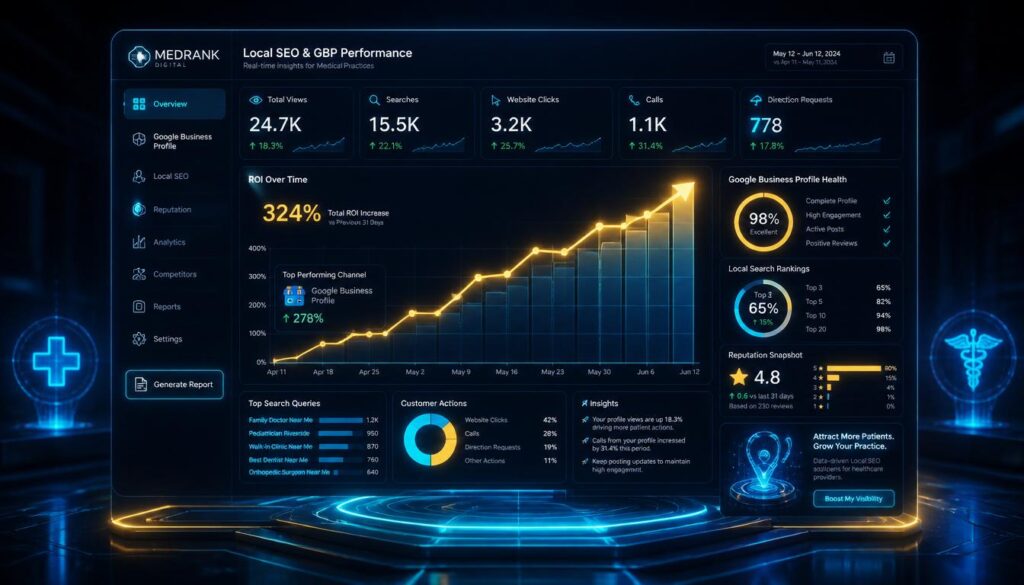
Track Performance With Google Business Profile Insights
Google Business Profile provides performance insights that help practices understand patient behavior.
Practices can monitor:
- Search queries
- Calls
- Website clicks
- Direction requests
- Photo views
- Engagement trends
This data helps practices identify which services and keywords attract the most attention.
For example, if many patients discover the practice through searches for “sports injury doctor,” the practice may choose to strengthen content related to orthopedic sports medicine.
Data-driven optimization can significantly improve long-term rankings.
Focus On Patient Experience
Ultimately, Google wants to recommend medical practices that provide excellent patient experiences.
Practices with strong reputations, helpful staff, clear communication, and positive patient interactions naturally perform better over time.
Online reviews, patient engagement, and local reputation all reflect real-world service quality.
Improving patient satisfaction often leads to:
- Better reviews
- More referrals
- Increased engagement
- Stronger brand trust
- Higher conversion rates
Local SEO success is closely tied to genuine patient satisfaction.
Build Trust Through Transparency
Transparency helps medical practices stand out in competitive healthcare markets.
Patients want clear information about:
- Services offered
- Insurance participation
- Office policies
- Provider credentials
- Appointment procedures
- Telehealth availability
The more transparent and informative your profile is, the easier it becomes for patients to choose your practice.
Trust signals also influence Google’s understanding of business quality.
Create Location-Specific Content
Medical practices serving multiple cities or neighborhoods should create localized content.
Examples include:
- Blog posts about community health topics
- City-specific service pages
- Local patient success stories
- Healthcare event coverage
Localized content strengthens geographic relevance and improves visibility for nearby searches.
For example, a pediatric clinic in Austin may publish content about seasonal allergies affecting local children.
This creates stronger connections between the practice and the local community.
Use Structured Data Markup
Structured data helps search engines better understand website content.
Medical practices can add schema markup for:
- Physicians
- Medical organizations
- Reviews
- Office locations
- Services
- FAQs
Proper schema implementation may improve search visibility and help Google connect website data with business profile information.
Technical SEO improvements often support stronger local rankings.
Compete Effectively Against Large Healthcare Networks
Independent medical practices often compete against hospitals and major healthcare systems with large marketing budgets.
Fortunately, local SEO can level the playing field.
Smaller practices can outperform large organizations by focusing on:
- Personalized patient experiences
- Strong reviews
- Community engagement
- Detailed local optimization
- Faster response times
Patients frequently prefer local providers who feel more accessible and community-focused.
A highly optimized Google Business Profile can help smaller practices capture significant local search traffic.
Stay Updated With Google Changes
Google frequently updates local search algorithms and profile features.
Medical practices should stay informed about:
- New profile features
- Local SEO updates
- Healthcare marketing trends
- Spam policy changes
- Review guidelines
Practices that adapt quickly often maintain stronger rankings.
Working with experienced healthcare SEO professionals may also help practices remain competitive.