How to Design the Best Cosmetic Surgery Clinic Website and Generate More Leads Organically
Why Is Your Cosmetic Surgery Website Failing to Convert High-Intent Patients Organically?
Many plastic surgery practices fall into a dangerous trap: they treat their website as a static, digital brochure rather than a highly calibrated conversion engine. When clinics seek to grow their patient pipeline, their immediate reflex is to pour tens of thousands of dollars into competitive Pay-Per-Click (PPC) search campaigns. While Google Ads can drive rapid traffic, the cost-per-click (CPC) for hyper-competitive transactional keywords like “plastic surgeon near me” or “breast augmentation surgeon” can easily exceed $30 per click in major metropolitan areas. This creates an expensive, unsustainable reliance on paid advertising.
The alternative is organic search engine optimization (SEO), but many medical websites fail to rank because they are built on slow, template-driven platforms containing superficial content. If your website consists of generic, 300-word descriptions of procedures—written in clinical jargon that alienates the reader—you will neither satisfy Google’s search algorithms nor reassure an anxious patient.
To dominate search results organically and transform casual browsers into scheduled consultations, your website must be designed with an intuitive user experience (UX), deep topical authority, and a meticulous understanding of patient psychology. Aesthetic medicine is a deeply personal, emotionally driven purchase. A patient is not merely buying a procedure; they are buying confidence, safety, and a transformation. Your website must reflect this by blending absolute clinical authority with low-friction, highly secure conversion pathways.
How Can You Leverage High-Volume, Low-Competition Keywords to Bypass Generic Search Competition?
Trying to rank on the first page of Google for short-tail keywords like “facelift” or “liposuction” is a monumental and often unprofitable task. The search engine results pages (SERPs) for these broad terms are dominated by massive medical journals, national organizations like the American Society of Plastic Surgeons (ASPS), and multi-million-dollar aggregator sites.
To win organically, you must target high-volume, low-competition long-tail keywords that demonstrate high commercial intent. When a patient searches for a highly specific query, they are much further along in the decision-making funnel. They are no longer wondering if they should get surgery; they are researching how it is done, the recovery process, and who they can trust to do it.
By targeting specific procedural variations and questions, you capture patients at the exact moment they are looking for specialized expertise. Below are critical keyword clusters that represent high-volume, lower-competition search opportunities for modern practices:
- Deep Plane Facelift Cluster:
- Primary Keyword: “deep plane facelift recovery time” (High search volume, lower keyword difficulty than “facelift cost”).
- Secondary Keywords: “SMAS vs deep plane facelift results”, “deep plane facelift scar placement”, “natural deep plane facelift surgeon”.
- Awake Liposuction Cluster:
- Primary Keyword: “awake liposuction vs traditional liposuction” (Excellent transactional intent, low competition as many older clinics do not offer or explain local anesthesia options).
- Secondary Keywords: “tumescent liposuction recovery timeline”, “awake lipo side effects”, “is awake liposuction safe”.
- Abdominoplasty Variations Cluster:
- Primary Keyword: “mini tummy tuck scar placement” (Highly targeted query from patients seeking minimal scarring).
- Secondary Keywords: “mini tummy tuck vs full tummy tuck recovery”, “abdominoplasty muscle repair pain”, “tummy tuck before and after without belly button repositioning”.
- Advanced Breast Aesthetics Cluster:
- Primary Keyword: “subfascial breast augmentation benefits” (A specific technique query showing high education and intent).
- Secondary Keywords: “dual plane vs subfascial breast implants”, “subfascial breast augmentation recovery days”, “rapid recovery breast augmentation protocol”.
When you build dedicated, in-depth landing pages addressing these exact queries, Google recognizes your site as a comprehensive topical authority. Furthermore, because these terms have lower competition, you can achieve first-page rankings much faster than you would targeting generic procedures.
How Does the Psychology of Your Before-and-After Gallery Determine Your Clinic’s Conversion Rate?
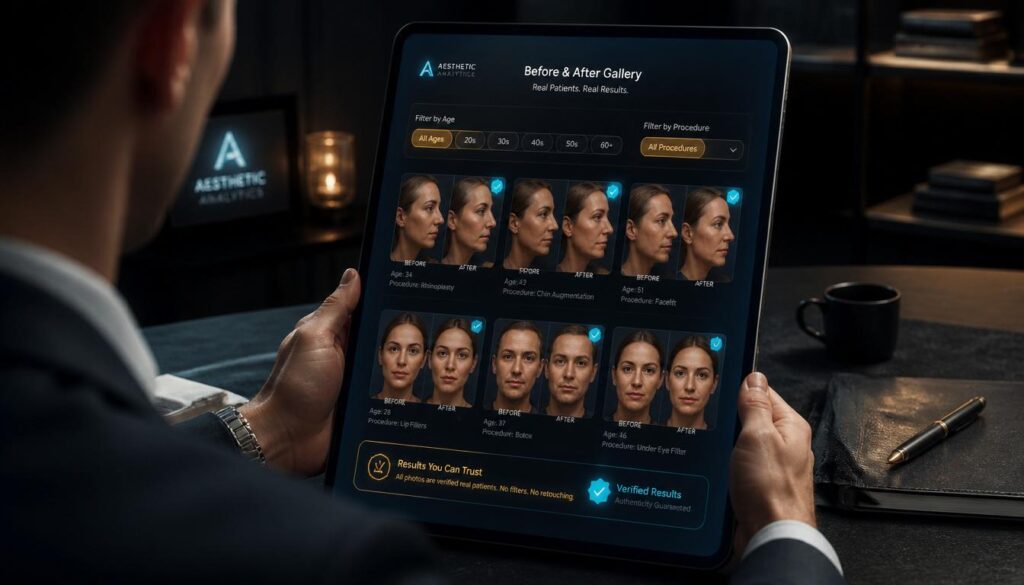
The before-and-after photo gallery is statistically the most frequently visited section of any cosmetic surgery website. Potential patients use this page to validate the surgeon’s artistic eye, consistency, and experience with bodies or faces that look exactly like theirs. However, most clinics treat their gallery as a simple image dump, missing a massive opportunity to optimize for search engines and user psychology.
To maximize organic conversions, your gallery must be designed around the concept of self-identification. A 52-year-old female looking for a facelift does not want to scroll through endless photos of 25-year-old breast augmentations. Your gallery must feature advanced filtering options allowing users to sort results by:
- Procedure (e.g., “Deep Plane Facelift”, “Mommy Makeover”)
- Patient Age (e.g., 30s, 40s, 50s, 60s+)
- Body Type / Starting Point (e.g., Body Mass Index ranges, specific anatomical concerns like “grade 3 breast ptosis”)
- Surgeon (if it is a multi-doctor practice)
From an SEO perspective, each before-and-after case study should have its own dedicated, crawlable page. Instead of using generic image files labeled image001.jpg, save and upload images with descriptive, keyword-rich names such as deep-plane-facelift-50-year-old-female-before.webp and deep-plane-facelift-50-year-old-female-after.webp.
Each case study page should contain 150 to 200 words of unique, structured content explaining the clinical context:
- Patient Concerns: What anatomical issues did the patient present with? (e.g., submental fullness, loss of jawline definition).
- Surgical Plan: Which procedures were performed? Use targeted terms like “extended deep plane facelift paired with submental platysmaplasty”.
- The Result: Highlight the natural-looking outcome, scar camouflage, and patient satisfaction.
To supercharge your organic rankings, implement image structured data (Schema markup) and use descriptive Alt Text. This tells Google’s image search algorithms exactly what is depicted, driving a steady stream of highly targeted traffic from users searching Google Images for real-life surgical outcomes.
Why Is Your Website’s Navigation Structure Causing Potential Patients to Click Away?
A confusing, cluttered navigation menu is a major source of friction that drives bounce rates up and organic rankings down. If a user has to click through three levels of generic dropdown menus just to find information on “mini tummy tuck recovery”, they will likely abandon your site and visit a competitor’s.
Your website architecture should follow a strict, logical Silo Architecture (often called a Hub-and-Spoke model). This design groups related content into distinct, isolated sections, making it incredibly easy for Google to crawl and crawl-map your site’s hierarchy.
In this structure, the “Facelift” hub page links out to highly specific spoke pages like “Deep Plane Facelift” and “Mini Facelift”. In turn, those spoke pages link back to the main “Facelift” page. This creates a tight web of internal links that passes search engine authority (PageRank) fluidly throughout your site.
Furthermore, ensure that your navigation labels use patient-friendly language alongside clinical terms. For example, instead of naming a navigation item “Blepharoplasty”, label it “Eyelid Surgery (Blepharoplasty)”. This satisfies both the search engine queries of highly educated patients and the layman search terms of those just beginning their research.
How Can You Design Lead Capture Forms That Feel Secure and Low-Friction for Sensitive Medical Inquiries?
The ultimate goal of organic traffic is to generate inquiries, but the standard contact form is often a massive bottleneck. Asking a patient to fill out a long, sterile form with 15 fields asking for detailed medical histories and phone numbers on their first visit will crush your conversion rates.
Because cosmetic surgery is an elective, highly personal medical field, lead capture forms must balance simplicity, psychology, and strict security:
Implement Progressive Profiling: Instead of presenting a massive, daunting form, use multi-step forms that guide the user through a low-friction journey. Step one might ask, “Which area of your body would you like to improve?” (with visual, clickable icons). Step two asks about their ideal timeline (e.g., “Within 3 months”, “Just researching”). Only in the final step do you ask for their name, email, and phone number to deliver their personalized assessment.
Leverage Interactive Assessment Tools: Introduce interactive “Am I a Candidate?” quizzes. A quiz titled “Are You a Candidate for a Mini Tummy Tuck?” not only captures highly qualified leads but also helps patients self-select. It provides immediate value to the user while feeding valuable clinical insights directly into your consultation pipeline.
Guarantee HIPAA Compliance: This is non-negotiable. If your website forms collect protected health information (PHI)—such as medical histories, photos for virtual consultations, or details of a physical condition—your entire hosting and form-capture infrastructure must be fully compliant with the Health Insurance Portability and Accountability Act (HIPAA). Ensure your forms use secure, end-to-end encryption, and that your website platform integrates with a HIPAA-compliant CRM or patient coordination tool (such as PatientNow, NexHealth, or Symplast). Displaying a small, subtle security badge or “HIPAA-Compliant Secure Form” label near the submit button instantly lowers user anxiety and builds deep trust.
How Do You Build Trust with Google and Users Using Medical E-E-A-T Guidelines?
In the medical and healthcare space, Google applies incredibly strict ranking standards known as YMYL (Your Money or Your Life). Because the content on a cosmetic surgery website can directly impact a patient’s physical health, safety, and financial well-being, Google demands the highest levels of E-E-A-T (Experience, Expertise, Authoritativeness, and Trustworthiness).
If your content is deemed low-quality, inaccurate, or written by anonymous copywriters with no medical background, Google will actively suppress your site in organic search results. To construct an unshakeable foundation of authority:
Introduce Comprehensive Surgeon Profiles: Your “About the Surgeon” page must go far beyond a generic resume. Highlight board certifications specifically from the American Board of Plastic Surgery (ABPS)—the gold standard recognized by the American Board of Medical Specialties. Detail active memberships in major bodies like the ASPS or the Aesthetic Society. Embed high-resolution photos of the surgeon in their operating room, short video interviews discussing their patient-care philosophy, and links to peer-reviewed publications or presentations they have delivered.
Implement Medical Review Workflows: Every single procedural page and blog post on your website must display a clear “Medically Reviewed By [Surgeon’s Name]” byline with a link to their credentials. This signal tells Google’s search quality raters and automated scrapers that the information presented has been vetted by an active, licensed medical expert.
Deploy Schema Structured Data: Use advanced Schema markup specifically designed for medical practices. This includes
MedicalWebPage,Physician, andSurgicalProcedureschemas. These microdata formats allow Google’s spiders to instantly read and index your clinic’s physical location, board certifications, office hours, and specific procedures offered, cementing your clinical footprint in the semantic web.

How Does Page Speed and Mobile-First Responsive Design Impact Your Organic Search Rankings?
Over 70% of prospective cosmetic surgery patients search, browse, and compare clinics on their mobile devices—often doing so in private moments when they are away from their desktop computers. If your website is not meticulously optimized for mobile devices, or if it takes more than 3 seconds to load, you are losing a massive portion of your organic audience.
Page speed is a direct, confirmed Google ranking factor under the Core Web Vitals initiative. High-resolution photos, interactive before-and-after sliders, and heavy video content are the lifeblood of an aesthetic website, but they are also the primary causes of slow loading times. To solve this critical bottleneck:
Apply Next-Gen Image Compression: Never upload raw PNG or JPEG files directly to your media library. Convert all images to next-generation formats like WebP or AVIF, which reduce file sizes by up to 80% without sacrificing visual sharpness or color accuracy.
Utilize Lazy Loading and CDNs: Implement “lazy loading” so that images and videos below the fold only load when the user scrolls down to them. Furthermore, distribute your media assets across a global Content Delivery Network (CDN) to ensure lightning-fast image delivery regardless of where the searcher is physically located.
Design for Thumb Navigation: On mobile screens, all interactive elements, before-and-after sliders, and lead capture forms must be easily clickable with a thumb. Avoid tiny, cramped text links or intrusive pop-ups that block the screen. Mobile visitors are often looking for immediate contact, so always embed a persistent, sticky “Book a Consultation” button at the bottom of the mobile viewport.
How Can You Leverage Local SEO and Google Business Profile to Capture Neighborhood Searchers?
Most cosmetic surgery patients are unwilling to travel long distances unless they are seeking a highly specialized celebrity surgeon. Therefore, the vast majority of your organic leads will come from your immediate geographic region. This makes local SEO and the optimization of your Google Business Profile (GBP) one of your highest-yield marketing channels.
When a potential patient searches for “best rhinoplasty surgeon in [Your City]”, Google displays the “Local Map Pack” at the very top of the organic search results. To dominate this premium real estate:
Enforce Strict NAP Consistency: Your clinic’s Name, Address, and Phone number (NAP) must be identical across every single digital platform, including your website, Google Business Profile, Yelp, RealSelf, and local medical directories. Even minor discrepancies (like writing “Suite 100” on your website and “Ste. 100” on Google) can dilute your local search engine authority.
Develop Geocentric Procedural Landing Pages: If your practice has multiple locations or aims to attract patients from surrounding affluent suburbs, build dedicated local landing pages. Instead of a single “Contact Us” page, design individual pages like
/procedures/deep-plane-facelift-beverly-hillsor/procedures/tummy-tuck-pasadena. These pages should contain specific local reviews, maps, driving directions, and local-centric copy to rank for hyper-local search queries.Cultivate and Manage Patient Reviews: The quantity, velocity, and sentiment of your Google reviews are critical ranking factors for local SEO. Establish a systematic, automated post-operative workflow that invites happy patients to share their experiences. To stay fully compliant with HIPAA, never confirm in a review reply that the user was a patient. Instead, respond to positive reviews with a warm, generalized thank-you, such as: “Thank you so much for sharing your feedback with our team! We strive to provide every visitor with exceptional care and a welcoming environment.”
How Do You Track and Measure Organic Lead Generation to Ensure Continuous Growth?
You cannot improve what you do not measure. To ensure your newly optimized cosmetic surgery website is actively generating leads and driving return on investment (ROI), you must establish a closed-loop tracking system that monitors organic search traffic from the first click to the final surgical booking.
A complete measurement framework requires integrating three essential tools:
Google Search Console (GSC): Use GSC to track which specific long-tail keywords are driving impressions and clicks to your site. Monitor your rankings for target terms like “subfascial breast augmentation benefits” to ensure your content-led SEO strategies are climbing the search results page.
Google Analytics 4 (GA4): Set up custom conversion events in GA4 to track exactly when a user completes a high-value action on your site. This includes tracking quiz completions, form submissions, phone call clicks, and self-scheduling bookings.
Call Tracking Software: Many high-value cosmetic patients prefer to call the clinic directly rather than filling out an online form. Implement dynamic call tracking (using platforms like CallRail) to attribute phone calls directly to the organic keyword search or page that brought the user to your site.
By analyzing this data monthly, you can pinpoint exactly which procedural pages are generating the most lucrative surgical consultations. This allows you to continuously refine your layout, update your before-and-after galleries, and scale your organic content engine to secure a continuous, compounding stream of new patient consultations without paying for a single ad.