
Why Does Your Insurance Agency Need A Content Strategy To Dominate Local Search?
Insurance agencies face intense competition online. Whether you sell auto insurance, home insurance, business insurance, life insurance, or specialty policies, potential clients are searching online before making decisions. Most people now use search engines to compare agencies, read reviews, learn about coverage options, and request quotes.
If your insurance agency does not appear in local search results, you are likely losing leads to competitors that invest in search engine optimization and content marketing.
A strong content strategy helps your agency improve visibility in local search results while building trust with potential customers. Instead of relying only on paid ads or referrals, your agency can attract consistent organic traffic from people actively searching for insurance services in your city or region.
Content marketing is no longer optional for agencies that want long-term growth. It supports local SEO, strengthens your reputation, educates prospects, and improves conversions.
This article explains why your insurance agency needs a content strategy to dominate local search and how the right approach can help you generate more qualified leads.
Understanding Local Search For Insurance Agencies
Local search refers to searches with geographic intent. People often search for insurance providers using phrases such as:
- • Auto insurance near me
- • Home insurance agency in Dallas
- • Best business insurance in Houston
- • Life insurance agents in Phoenix
- • Affordable car insurance in Miami
Search engines try to provide users with the most relevant local results based on location, relevance, trust, and authority.
When someone searches for insurance services in your area, search engines analyze several factors, including:
- • Your website content
- • Your Google Business Profile
- • Online reviews
- • Backlinks
- • Location relevance
- • Website authority
- • User experience
- • Local citations
Your content strategy directly affects many of these ranking factors.
Without useful and location-focused content, your agency may struggle to rank for valuable local keywords.
Content Helps Your Agency Rank For Local Keywords
One of the biggest reasons your insurance agency needs a content strategy is keyword visibility.
People search for insurance information in many different ways. Some are ready to buy immediately, while others are researching options.
A well-planned content strategy allows your agency to target keywords throughout the customer journey.
For example, your agency can create content around:
- • Auto insurance requirements in your state
- • How to lower home insurance costs
- • Best insurance coverage for small businesses
- • Flood insurance tips for homeowners
- • What first-time drivers should know about insurance
- • Commercial insurance for contractors
You can also target city-specific keywords such as:
- • Home insurance in Tampa
- • Business insurance in Austin
- • Auto insurance agents in Atlanta
These local pages and blog posts help search engines understand where your business operates and what services you offer.
The more relevant content you publish, the more opportunities your website has to appear in search results.
Content Builds Trust With Potential Clients
Insurance is a trust-based industry.
Most people do not purchase insurance from a company they know nothing about. They want to work with agencies that appear knowledgeable, reliable, and professional.
High-quality content helps establish your agency as an authority in your market.
When your website answers important questions clearly, visitors begin to trust your expertise.
For example, educational blog posts can explain:
- • Deductibles
- • Coverage limits
- • Liability protection
- • Claims processes
- • Policy exclusions
- • Risk management
Simple and informative content helps potential clients feel more confident when contacting your agency.
Instead of sounding overly sales-focused, your agency becomes a helpful resource.
This trust can improve conversion rates because prospects already feel informed before they request a quote.
Localized Content Gives You A Competitive Advantage
Many insurance agencies make the mistake of using generic website content.
Generic content does not help your agency stand out in local search.
Localized content creates a stronger connection between your agency and your community.
For example, you can create articles about:
- • Hurricane insurance preparation in Florida
- • Wildfire insurance risks in California
- • Winter storm claims in Colorado
- • Flood risks in Texas
- • Small business insurance trends in your city
This type of location-specific content signals local relevance to search engines.
It also shows potential clients that your agency understands regional concerns and insurance needs.
Local content can include:
- • City landing pages
- • Community event coverage
- • Local insurance guides
- • Regional risk discussions
- • State insurance law updates
- • Neighborhood-specific insurance advice
Agencies that consistently publish localized content often outperform competitors that rely on generic national content.
Content Supports Your Google Business Profile
Your Google Business Profile plays a major role in local search visibility.
However, your website content also supports your local map rankings.
Google looks for consistency between your website and your business profile.
For example, if your profile says you offer:
- • Auto insurance
- • Home insurance
- • Commercial insurance
- • Life insurance
Your website content should strongly reinforce those services.
Publishing detailed service pages and blog content improves topical relevance.
This helps search engines better understand your expertise and service areas.
Content can also drive traffic to your Google Business Profile through:
- • Local searches
- • Branded searches
- • Blog articles
- • FAQ pages
- • Location pages
Together, your content and business profile strengthen your local SEO presence.
Fresh Content Signals Website Activity
Search engines prefer websites that remain active and updated.
An outdated insurance website with little content may appear less relevant than competitors that regularly publish new information.
A content strategy helps keep your website fresh.
Regular blog posts, articles, FAQs, and service updates signal ongoing activity.
Fresh content can improve:
- • Search engine crawling
- • Indexing frequency
- • Keyword rankings
- • User engagement
- • Organic traffic
For example, your agency can publish seasonal content such as:
- • Hurricane preparedness insurance tips
- • Winter driving insurance advice
- • Open enrollment guides
- • Summer travel insurance recommendations
Timely content helps attract searches related to current events and seasonal insurance concerns.
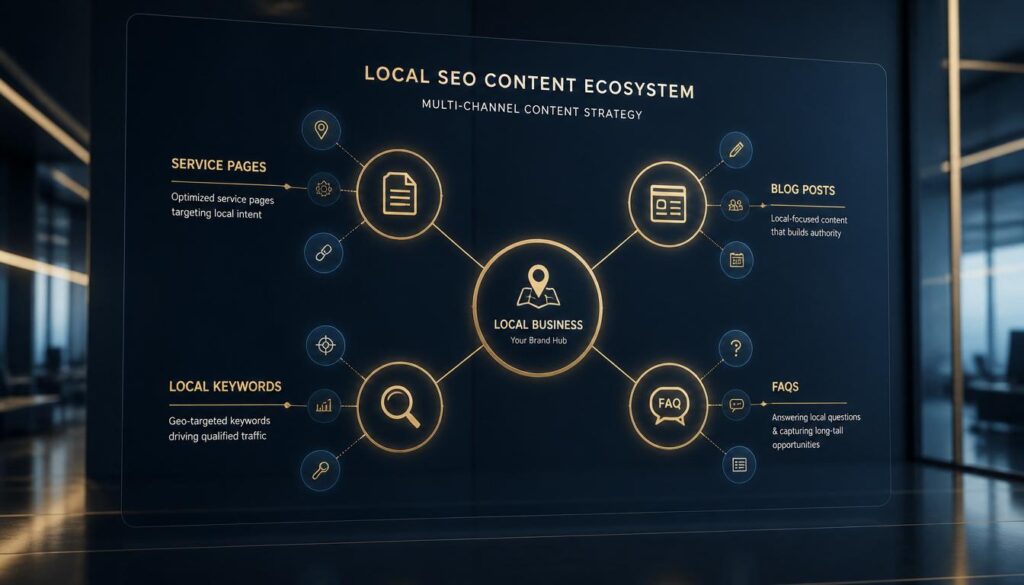
Content Helps You Capture Long-Tail Searches
Many insurance-related searches are highly specific.
These are called long-tail keywords.
Examples include:
- • Best auto insurance for teen drivers in Chicago
- • Small business liability insurance for restaurants
- • How much flood insurance do I need in Houston
- • Cheap motorcycle insurance for college students
Long-tail searches often have lower competition and higher conversion intent.
A strong content strategy allows your agency to target these valuable searches.
Instead of competing only for broad terms like “insurance agency,” you can rank for hundreds of highly targeted phrases.
This creates more opportunities to attract qualified local traffic.
Long-tail content also helps your agency connect with people who are closer to making a purchase decision.
Educational Content Improves Customer Experience
Insurance can feel confusing to many consumers.
People often have questions about coverage, pricing, exclusions, and claims.
Educational content improves the customer experience by simplifying complex topics.
Helpful articles, videos, and FAQs can answer common concerns before prospects contact your office.
Examples include:
- • What affects car insurance rates
- • How homeowners insurance claims work
- • What renters insurance covers
- • How umbrella insurance protects assets
- • What commercial liability insurance includes
Educational content reduces confusion and helps visitors feel more prepared.
This can shorten the sales process because potential customers already understand basic insurance concepts.
It can also reduce repetitive questions for your staff.
Content Helps Generate Qualified Leads
Not all website traffic is valuable.
Insurance agencies need qualified leads from people genuinely interested in coverage.
A targeted content strategy attracts users searching for specific insurance solutions.
For example, someone reading an article titled:
“Do Small Businesses In Dallas Need Cyber Liability Insurance?”
is likely a strong commercial insurance prospect.
Similarly, a person reading:
“How Much Home Insurance Do You Need In Coastal Florida?”
may already be considering policy options.
When your content matches user intent, you attract higher-quality traffic.
This often leads to:
- • More quote requests
- • More phone calls
- • Better conversion rates
- • Higher customer retention
Strategic content helps move users from research to action.
Content Strengthens Your Authority In Competitive Markets
Insurance is highly competitive in many cities.
Large national brands often dominate paid advertising.
However, local agencies can compete effectively through content marketing.
Local expertise gives smaller agencies an advantage.
Your agency understands:
- • Regional risks
- • State regulations
- • Local communities
- • Neighborhood trends
- • Local business environments
Content allows you to showcase that expertise.
Over time, consistent publishing builds authority with both search engines and consumers.
Authority improves your chances of ranking higher for competitive local keywords.
It also helps your agency appear more credible than competitors with weak or outdated websites.
Content Supports Other Marketing Channels
Your content strategy does more than support SEO.
It also strengthens other digital marketing efforts.
For example, blog posts can be repurposed into:
- • Social media posts
- • Email newsletters
- • Video scripts
- • Infographics
- • FAQ pages
- • Sales materials
This creates a more consistent marketing message across multiple channels.
Content also gives your agency valuable resources to share with leads and clients.
For example, agents can send educational articles to prospects after consultations.
This keeps your agency engaged with potential customers while reinforcing expertise.
Frequently Asked Questions Improve Local SEO
FAQ content is especially valuable for insurance agencies.
People constantly search for insurance-related questions online.
Examples include:
- • Is flood insurance required?
- • Does home insurance cover roof leaks?
- • What happens after a car accident claim?
- • How much business insurance do I need?
- • Does renters insurance cover theft?
Creating FAQ pages helps your website rank for question-based searches.
FAQs also improve user experience by delivering quick answers.
Search engines sometimes feature FAQ content directly in search results.
This can improve visibility and increase click-through rates.
Including local references in FAQ content can further strengthen local SEO.
For example:
- • Do Texas homeowners need separate windstorm insurance?
- • What are minimum auto insurance requirements in Arizona?
Localized FAQ content makes your website more relevant for regional searches.
Content Can Earn Valuable Backlinks
Backlinks remain an important ranking factor in SEO.
When reputable websites link to your content, search engines view your site as more trustworthy.
High-quality content increases the likelihood of earning backlinks naturally.
For example, local organizations, news outlets, blogs, or business associations may link to:
- • Insurance guides
- • Community resources
- • Data studies
- • Risk prevention articles
- • Local safety reports
Backlinks improve your domain authority and strengthen your local search performance.
Without strong content, earning quality backlinks becomes much harder.
Consistent Content Improves Brand Recognition
People may not purchase insurance immediately after visiting your website.
However, repeated exposure to your content increases brand awareness.
When potential clients repeatedly see your agency in search results, they become more familiar with your business.
This familiarity builds trust over time.
Consistent content publishing keeps your agency visible throughout the customer journey.
For example, a prospect may:
- • Read a blog post today
- • Follow your social media next week
- • Request a quote a month later
Content helps maintain visibility until the customer is ready to buy.
Content Helps Agencies Adapt To Voice Search
Voice search continues to grow as more people use smartphones and smart devices.
Voice searches often sound more conversational.
For example:
- • Who offers affordable car insurance near me?
- • What is the best home insurance company in my city?
- • How much renters insurance do I need?
Content strategies that include conversational language and FAQ pages can help your agency appear in voice search results.
Natural language content aligns better with how people speak during voice searches.
This creates additional opportunities for local visibility.
Service Pages Are Critical For Local Search
Many insurance agencies rely on one generic services page.
This limits SEO opportunities.
A strong content strategy includes dedicated service pages for each insurance product.
Examples include:
- • Auto insurance
- • Home insurance
- • Life insurance
- • Business insurance
- • Renters insurance
- • Motorcycle insurance
- • Workers’ compensation insurance
- • Cyber liability insurance
Each page should include:
- • Detailed information
- • Local references
- • Coverage explanations
- • Frequently asked questions
- • Clear calls to action
Dedicated service pages help search engines understand your expertise and improve ranking potential.
Content Improves Conversion Rates
SEO traffic alone is not enough.
Your website also needs to convert visitors into leads.
Helpful content improves conversion rates by addressing objections and answering questions.
For example, prospects may hesitate because they:
- • Do not understand coverage
- • Fear high premiums
- • Feel overwhelmed by choices
- • Worry about claims processes
Educational content can reduce these concerns.
When visitors feel informed and confident, they are more likely to:
- • Request a quote
- • Call your office
- • Fill out a contact form
- • Schedule consultations
Good content guides visitors toward taking action.
Analytics Help Improve Your Content Strategy
One major advantage of content marketing is measurable performance.
Your agency can track:
- • Website traffic
- • Keyword rankings
- • Conversion rates
- • Time on page
- • Bounce rates
- • Lead generation
Analytics help identify which topics generate the most traffic and leads.
This allows your agency to refine future content strategies.
For example, if commercial insurance articles perform well, you can expand content around business coverage.
Data-driven decisions improve marketing efficiency and ROI.
Content Marketing Delivers Long-Term Value
Paid advertising stops generating leads when your budget ends.
Content marketing continues working long after publication.
A strong article can attract traffic for months or even years.
Evergreen insurance content provides ongoing visibility and lead generation.
For example, articles about:
- • Insurance basics
- • Claims processes
- • State insurance requirements
- • Coverage comparisons
can remain useful over time.
This creates long-term SEO value that compounds as your content library grows.
Over time, your website becomes a stronger authority in local search.
How To Build A Strong Insurance Content Strategy
Successful insurance content strategies require planning and consistency.
Key steps include:
Identify Your Target Audience
Understand your ideal clients.
This may include:
- • Homeowners
- • Small business owners
- • Families
- • Contractors
- • Real estate investors
- • Young drivers
Different audiences have different insurance concerns.
Your content should address their specific needs.
Perform Keyword Research
Research local insurance keywords and customer questions.
Look for:
- • Service keywords
- • Location keywords
- • Long-tail searches
- • Frequently asked questions
Keyword research helps identify content opportunities.
Create Localized Content
Develop city-specific and region-specific pages.
Discuss local insurance issues, weather risks, and regulations.
Localized content improves relevance and search visibility.
Publish Consistently
Consistency matters more than volume.
A regular publishing schedule helps maintain website activity.
Even publishing two to four high-quality articles monthly can produce strong long-term results.
Optimize For SEO
Use proper SEO practices, including:
- • Title tags
- • Meta descriptions
- • Internal links
- • Header structure
- • Mobile optimization
- • Fast loading speeds
Technical optimization supports content performance.
Update Older Content
Review and refresh outdated articles regularly.
Updated content can improve rankings and accuracy.
Insurance laws and market conditions change over time.
Fresh updates help maintain credibility.
Common Content Mistakes Insurance Agencies Should Avoid
Some insurance agencies struggle with content marketing because they make avoidable mistakes.
Common issues include:
Publishing Thin Content
Very short or low-quality articles often fail to rank.
Content should provide meaningful value.
Ignoring Local SEO
Generic content without local relevance limits visibility.
Include cities, neighborhoods, and regional concerns naturally.
Writing Only Sales Content
Overly promotional content can reduce trust.
Focus on education and helpful information.
Neglecting Mobile Users
Many insurance searches happen on mobile devices.
Your website should load quickly and display properly on smartphones.
Inconsistent Publishing
Long gaps between content updates can weaken SEO momentum.
Consistency is important for long-term growth.